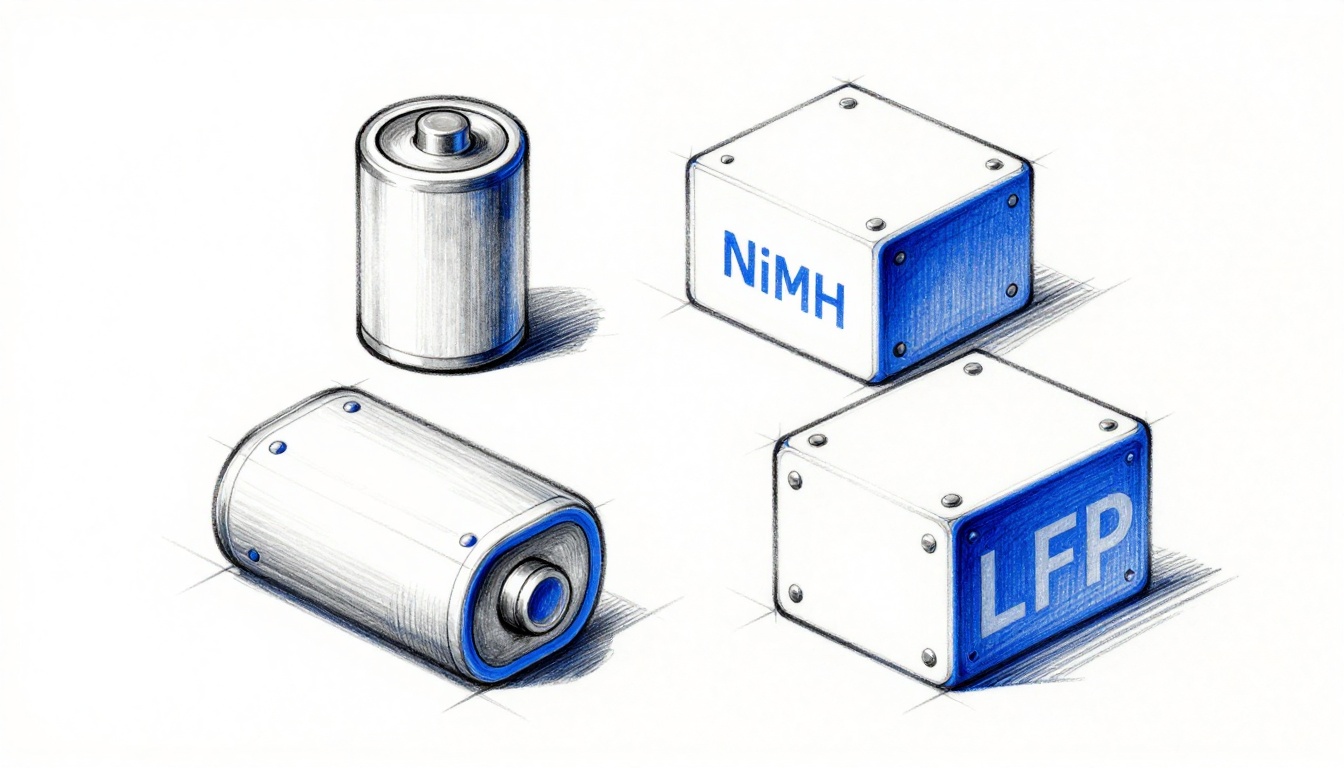
You can lose hours of work or a full day of plans just because the wrong battery type dies too early. For example, a phone that shuts off mid-day, or a backup pack that fails during a power outage, often leads to quick fixes and expensive replacements. In 2026, choosing the right chemistry matters because performance, cost, and safety vary widely by use.
You need a battery that fits your real demands, not just a label on a shelf. Energy density affects runtime, recharge cycles control long-term cost, and power output decides whether a device can start, boost, or handle peaks without stress. Also, safety risks differ by chemistry, so what works in a toy compartment may not be acceptable for home storage or an EV pack.
No single option fits all needs, so the “best” choice depends on application and operating conditions (temperature, charge rate, duty cycle, and whether you can service the system). Next, you’ll compare the main best battery types 2026 options, including alkaline, NiMH, Li-ion (NMC, NCA), lead-acid, LFP, LMFP, plus sodium-ion and solid-state, then map each to the applications where it performs best.
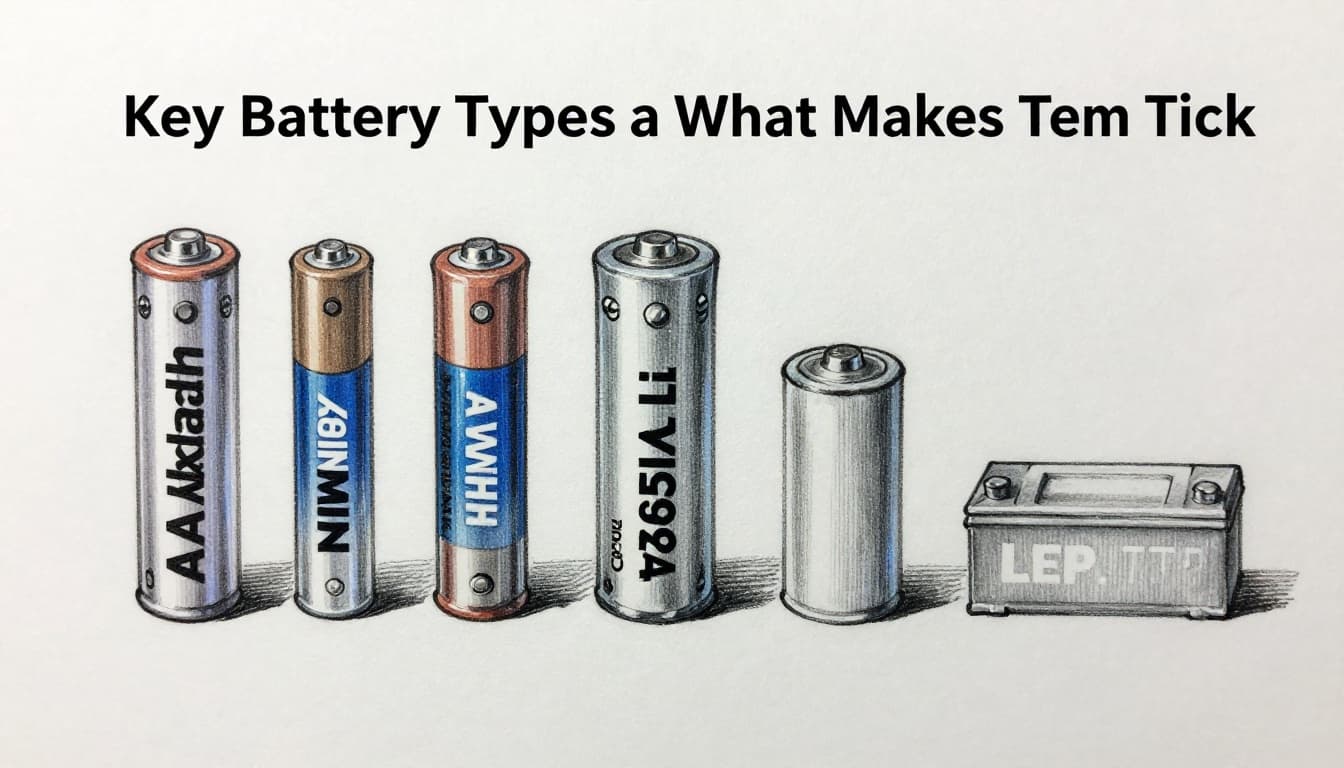
Key Battery Types and What Makes Them Tick
Battery chemistry controls what a cell can safely do under load, at temperature, and over repeated charge cycles. In practical terms, energy density determines how long you run before replacement, cycle life controls total lifetime cost, and safety behavior sets how tolerant the battery is when something goes wrong.
Because 2026 use cases differ, the “best” option depends on duty cycle, peak power needs, and whether the system includes controls like a charger or battery management system (BMS). The table below summarizes the primary trade-offs that matter most when selecting between alkaline, NiMH, lithium-ion (NMC/NCA), and lithium iron phosphate (LFP/LMFP).
| Chemistry | Best fit in plain terms | Energy density | Cycle life (typical) | Safety posture | Cost trend | Quick reality check |
|---|---|---|---|---|---|---|
| Alkaline (primary) | Low-drain remotes, clocks | Low to medium | Not designed for cycles | High | Lowest | Replace often; don’t recharge |
| NiMH (rechargeable AA) | Higher-drain gadgets with bursts | Medium | ~1,000 cycles | High | Low | Better rechargeable, still lower energy |
| Li-ion NMC | Range and performance needs | High | ~300 to 500 cycles | Mixed | Higher | Strong output, but needs tight controls |
| Li-ion NCA | High density, performance | Very high | ~300 to 500 cycles | Mixed | Higher | More demanding thermal management |
| LFP | Long life, storage, daily cycling | Medium | 2,000+ cycles | Very high | Lowest long-term | Heavier for same range |
| LMFP | LFP safety with higher energy | Medium | 2,000+ cycles | Very high | Low to mid | Often better cold behavior than LFP |
| Lead-acid | Budget backup, heavy duty | Medium | 200 to 1,000 cycles | Moderate | Lowest upfront | Heavy and less efficient |
For clarity, cycle counts assume proper charging within limits, and safety assumes compatible hardware. If the system lacks protections, the chemistry alone will not correct misuse.
Alkaline and NiMH: The Reliable Basics
For many households, alkaline and NiMH still cover the highest number of everyday battery slots. Their governing advantage is predictability, and their operating constraint is energy efficiency.
Alkaline AA cells (non-rechargeable) function like disposable power canisters. They provide steady voltage through low-drain use, and they remain inexpensive.
- Alkaline AA (typical): around 3000 mAh capacity, about steady 1.5V
- Rechargeability: not intended; performance degrades and risks increase if recharged
- Best use: remotes, wall clocks, smoke alarms (when specified), and similar low-drain devices
NiMH batteries then shift the policy. NiMH operates as a rechargeable reserve tank, and it better tolerates repeated charge-discharge cycles.
- NiMH AA (typical): around 2500 mAh capacity
- Cycle life: around 1,000 cycles when charged properly
- Performance behavior: better suited for higher-drain and burst loads than alkaline
In everyday terms, alkaline is often the lowest-cost pass when you replace rather than recharge. NiMH is the cost-controlled option when you run higher drain, cycle often, or want fewer trash replacements.
Main trade-off, however, remains energy density. Both alkaline and NiMH lose ground versus lithium chemistries when runtime per weight or size matters. In cold weather, NiMH can also show reduced output, and load-heavy gadgets may see faster voltage sag.
Li-ion Family: Powerhouses with Trade-offs
Li-ion chemistries operate under a different rule set. They trade higher energy output for higher sensitivity to charging limits, temperature, and pack controls. Therefore, selection should match hardware protections, especially the charger and the BMS.
Within lithium-ion, NMC and NCA typically target higher energy and stronger performance. These chemistries are commonly associated with EV-grade pack designs because they can support longer range needs.
- NMC: about 3000 to 4000 mAh class performance targets (cell dependent), roughly 300 to 500 cycles
- NCA: similar cycle window, often chosen for top density and power, but still requires strict thermal management
- Safety posture: fire risk exists if thermal runaway conditions develop, so pack cooling and monitoring are required
Then, LFP and LMFP provide a different compliance approach. They emphasize stable chemistry and long cycling, which is why they often appear in EVs and grid-adjacent storage.
- LFP: generally safer with 2,000+ cycles, but medium energy and more bulk for the same range
- LMFP: an LFP variant that aims for better energy than LFP and can offer better cold-weather charging behavior
When comparing LFP versus NMC, the decision typically follows a single axis: lifetime safety and cycle count versus maximum energy density. If you want fewer swaps and stronger tolerance for daily cycling, LFP tends to satisfy that requirement. If you prioritize range and light pack size, NMC tends to win.
For a practical side-by-side review, see LFP vs NMC in electric cars.
Market behavior supports that split. CATL and BYD are widely associated with LFP scaling, including high-volume designs that prioritize longevity and safety. As a result, these lithium subtypes can be treated as a policy choice between density-first and life-first operation.
Best Batteries to Keep Your Gadgets Going All Day
All-day operation depends on two measurable obligations: energy available (how long the device runs) and power delivery stability (how well the battery holds voltage during spikes). Therefore, the “best” choice differs by device class, because phones, laptops, cameras, and toys draw power in different patterns, and because charging rules apply differently across chemistries.
Phones and Laptops: Why Li-ion Dominates
For phones and laptops, Li-ion is the primary compliant choice because it supports high energy density and practical recharge behavior. In 2026, typical smartphone packs commonly fall in the 5,000 to 10,000 mAh range, depending on the model, which aligns with daily runtime targets under mixed loads (streaming, messaging, GPS, and background sync). Meanwhile, laptop packs commonly use higher-voltage Li-ion formats (often 50 to 100 Wh class in typical systems), which supports sustained compute without bulk that would violate portability needs.
Because day-long use often includes short, repeated peaks (screen brightness changes, radio bursts, and fast wake cycles), Li-ion also provides a usable voltage profile that fits modern power management. However, misuse controls apply. If you overcharge (or repeatedly charge beyond the device’s intended limit), the pack can degrade faster, and capacity retention will drop earlier than expected.
For faster-charge compliance, silicon-anode updates are relevant. In early reporting, Lenovo disclosed a silicon-anode notebook battery concept aimed at higher energy density, and this direction supports faster, fuller performance under controlled charging conditions, compared with older graphite-only designs. See Lenovo’s 1,000Wh/L silicon-anode battery announcement.
To maintain all-day reliability, you should also treat charge behavior as part of device ownership policy. Use manufacturer chargers, avoid charging in extreme heat, and do not store devices at 100% charge for extended periods unless the battery management system explicitly supports it.
Cameras and Toys: NiMH Edges Out for Power Bursts
For cameras and many power-hungry toys, NiMH can outperform alkaline in day-to-day use because its discharge stays steadier under load. Alkaline cells may advertise higher nominal capacity, but they often show a steeper voltage drop when the device demands quick bursts (flash, motor drive, or rapid capture). NiMH, by contrast, maintains a more usable voltage during peaks, so the device continues operating without early cutoffs.
In high-drain testing, NiMH has demonstrated meaningfully longer runtime than alkaline under burst conditions, even when the stored capacity figures appear lower on paper. This behavior matches the real-world pattern: cameras do not consume power smoothly, they consume it in spikes, so battery voltage stability becomes the deciding factor.
For sourcing and safety compliance, the following controls apply when selecting rechargeable cells:
- Buy reputable brands and avoid marketplace listings that claim unreal capacities.
- Check charging compatibility (NiMH requires compatible chargers; lithium chargers are not interchangeable).
- Inspect packaging and labeling for consistent model codes, voltage ratings, and manufacturer identifiers.
If you need a practical shortlist for NiMH AA picks, consult NiMH battery reviews from ODG.
Cordless Drills and Saws: Li-ion Cylinders Shine
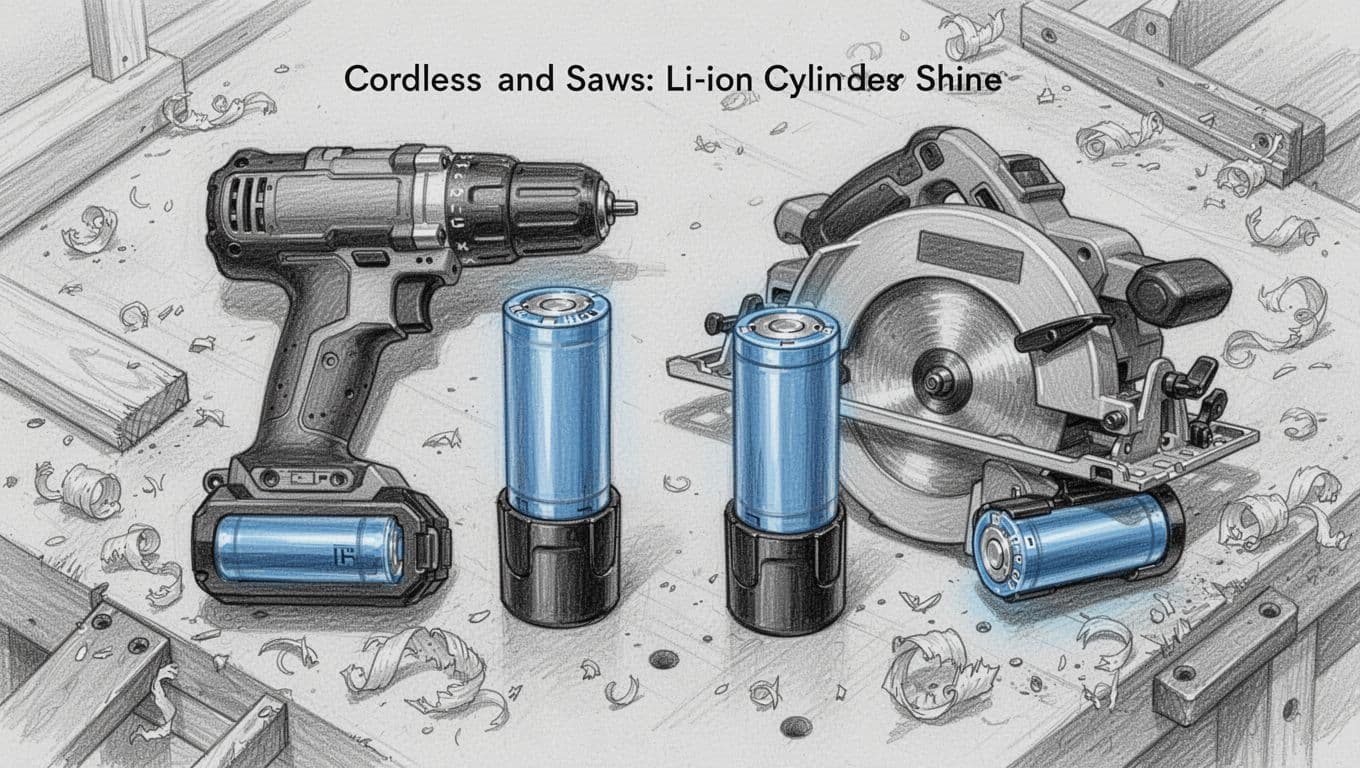
Cordless drills and saws demand high power, not just battery “capacity.” When the cut load spikes, the battery must deliver current fast, hold voltage under stress, and stay cool enough to avoid shutdown. In 2026, that performance requirement is where Li-ion cylindrical cells, especially 21700 and 4680 formats, consistently outperform the alternatives.
These cylindrical cells also match how modern tool packs are engineered. A drill does short bursts of torque. A saw runs longer with frequent load changes. Therefore, the battery system needs strong discharge ability, good thermal behavior, and consistent output across the job.
Why “High Power Output” Matters Under Load
Battery marketing often focuses on runtime, but power tools live on load. During drilling, the motor draws current spikes as the bit contacts material. During sawing, the load rises at each cut angle and depth change. If the battery cannot supply that surge, the tool slows, bogs down, or stops early.
In practice, Li-ion cylindrical cells win for three operational reasons:
- High discharge rate: they support higher amps without severe voltage sag.
- Stable voltage profile: the tool keeps speed and cutting feel as the pack discharges.
- Better thermal headroom: the pack manages heat so performance stays consistent.
By contrast, many other chemistries can deliver energy but struggle with peak current. That gap shows up as reduced cutting speed, slower drilling, and more frequent charge cycles during a full day of use.
If you want a plain explanation of how these packs differ in build, see Power tool battery technology breakdown. It connects cell behavior to what you feel at the tool.
How 21700 and 4680 Cells Beat Smaller Cylinders
Within cylindrical Li-ion, the main advantage comes from the cell format itself. Larger cells, such as 21700 and 4680, give pack designers more room for active material and improved current handling. As a result, the tool pack can store more usable energy and deliver stronger output while keeping weight and size within practical limits.
In addition, modern packs increasingly use designs that improve how current flows. Brands have pushed toward improved internal layouts and cooler operation, which helps with both sustained cutting and repeated starts. For a brand-focused view of how tool makers have been moving, review battery innovation leaders update.
For a worksite buyer, the practical takeaway is straightforward. When a drill or saw runs hard, you want a pack that maintains speed at the moment it counts, not after the tool has already slowed. Cylindrical Li-ion packs are built for that demand.
Comparing Li-ion Cylinders to NiMH, LFP, and Lead-Acid for Tough Cuts
The choice is not only about “rechargeable versus not.” It is also about whether the chemistry and form factor match the current demand of power tools. Here is how the common alternatives typically behave in high-drain work.
NiMH (rechargeable AA systems and older pack formats) can work, but it generally costs you in peak performance and efficiency. Under heavy load, NiMH voltage can dip enough to change the tool feel. Also, self-discharge can reduce readiness if tools sit between jobs.
LFP (LiFePO4 and similar) brings strong safety and long cycle life, but it often provides less peak punch for the same pack size. For tasks that require maximum torque or immediate speed, that limitation can show up as slower cutting and longer tool-run times.
Lead-acid is largely outmatched for cordless drilling and sawing. It is heavy for the energy stored, and it does not meet the high current draw needed for modern motor control without bulky pack designs.
A concise rule applies. If your work includes hard starts and frequent load surges, select Li-ion cylindrical packs designed for high discharge. For lower-drain applications, you can consider other chemistries, but drills and saws usually keep score on output.
Practical “Durability Through the Job” Checks for Pros
Durability in real work does not only come from cell chemistry. It also depends on pack design, charging habits, and how you store tools between shifts. Therefore, buyers who expect a battery to last through repeated jobs should verify the following items before committing.
- Confirm the cell format (cylindrical 21700 or 4680) for high-drain tools, not just the word “Li-ion.”
- Use compatible chargers that follow the pack’s voltage and charge profile, because mismatched charging increases stress.
- Inspect for thermal protection behavior. If the tool cuts out often during heavy cuts, the pack may be too hot or too small for the work.
- Track cycle life realistically. Even top chemistries fade with age, heat, and repeated full charges.
Storage practices matter as well. If a pack sits for weeks, storing it fully charged can reduce long-term capacity. Instead, keep packs in a moderate state of charge when the manufacturer guidance allows it.
For buyers comparing formats like 18650 versus 21700 versus 4680, this industrial market overview helps explain why each step involves trade-offs at the system level: From 18650 to 21700 to 4680.
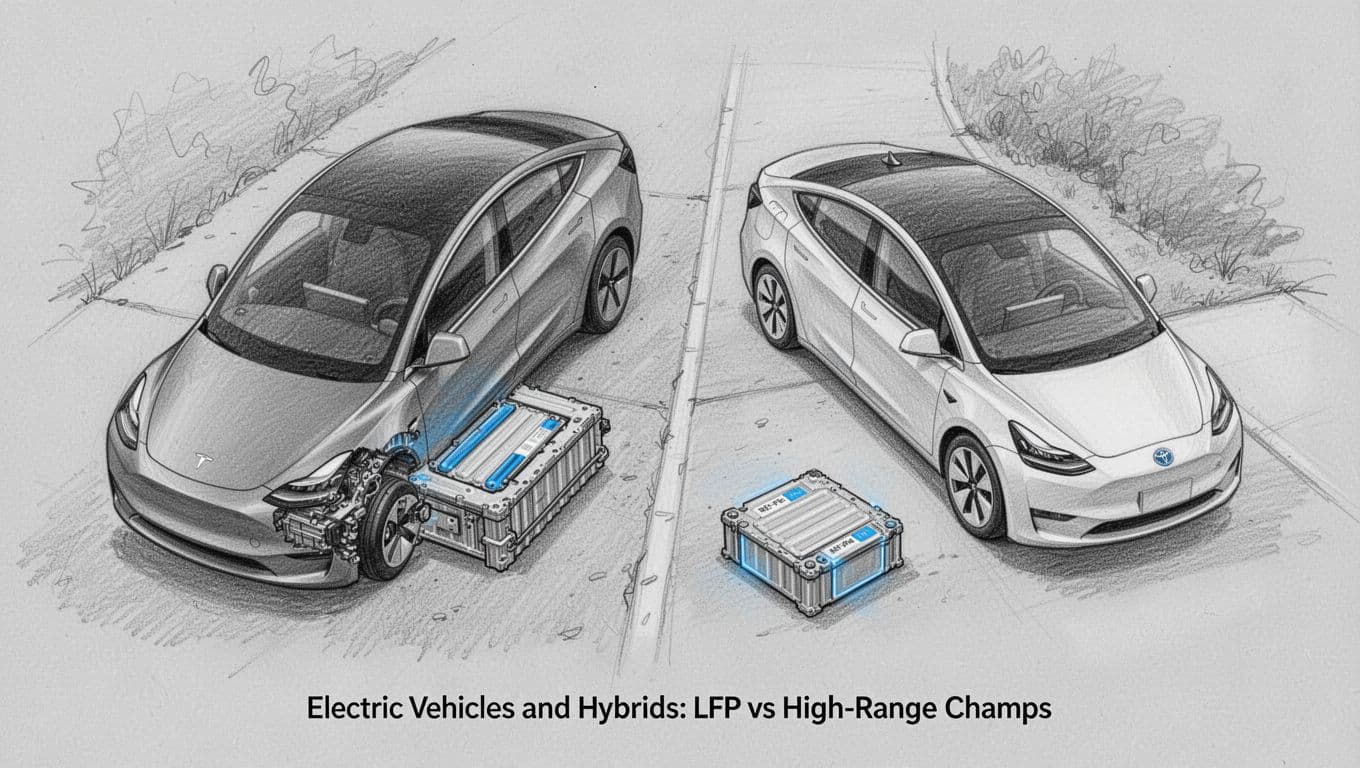
Electric Vehicles and Hybrids: LFP vs High-Range Champs
For 2026, the practical split in passenger vehicles is still predictable. LFP is typically selected for safer use and lower total cost. Meanwhile, NMC/NCA is still used when the design needs top energy density for long range.
LFP’s position matters because market behavior supports it. Real-world adoption has placed LFP at a dominant share of EV battery volume, with industry reporting describing LFP at over half of the global EV battery market in 2026, driven by lower cost and improved safety. As a result, many mainstream models treat LFP as the default, not an exception.
For the same vehicle class, the selection logic usually follows a duty-cycle style. If the vehicle runs daily, with fast charging and repeat cycles, LFP’s long cycle life and stable thermal behavior reduce long-term risk. In administrative terms, the battery system’s protections matter, but chemistry sets the baseline tolerance. LFP tends to handle heat events more safely than nickel-rich chemistries, which makes it easier for manufacturers to meet strict safety expectations.
Here, a second driver appears: procurement and supply chain stability. Because LFP avoids nickel and cobalt, it generally supports more predictable pricing. That pricing stability can also show up as lower sticker prices, especially for standard trims.
Hybrids, meanwhile, typically do not need the same energy density target as an all-electric vehicle. NiMH remains relevant for hybrid duty because it handles frequent charging and partial cycling well, and it offers reliable output during start-stop operation. If the hybrid pack acts more like a steady buffer than a long-haul energy tank, NiMH often stays within cost and reliability limits.
When LFP is the safer, cheaper default for EVs
LFP’s fit is usually most defensible in standard EVs and entry to mid trims. In these designs, the target range still meets customer expectations, but the priority shifts to cost per kWh delivered over a long ownership window.
Operationally, LFP also reduces the number of constraints a driver must think about. The pack can cycle more often, and the chemistry is comparatively tolerant when charging systems operate within designed limits. This does not remove the need for a functioning BMS and charger, but it reduces how often safety margin becomes a concern.
In many cases, buyers get a straightforward trade: slightly lower range for the same vehicle space, in exchange for safer heat handling and longer life. As a reference point for the chemistry tradeoffs in EV use, see LFP vs NMC Battery in Electric Cars: 2026 Comparison.
Why NMC and NCA still win for long-range performance
NMC and NCA chemistries remain the standard choice when designers must pack more energy into fewer liters. In long-range EVs, the system often needs maximum usable Wh, especially when targets extend beyond 400 miles under real driving conditions.
However, this performance comes with a stricter obligation set. Nickel-based packs generally rely on tighter thermal control and charging discipline. When users repeatedly push the limits, the pack tends to lose capacity faster over time than LFP, assuming comparable system quality.
From a compliance perspective, nickel-rich chemistries still require robust system protection. If the vehicle’s control software, cooling, and charge limits do not perform, degradation risk rises.
NiMH in hybrids: old chemistry with consistent job coverage
NiMH stays common in hybrids because the application does not require the same energy density as full EV range. Hybrid packs also tend to run in a pattern of partial charge and partial discharge, which matches NiMH’s strengths.
In short, NiMH acts as a dependable middle layer between the engine and the motor. It supports regenerative braking and stop-start behavior without forcing the vehicle to carry a very large high-energy pack.
For buyers, the takeaway is operational, not nostalgic. If the hybrid’s job is short-trip efficiency and power buffering, NiMH often remains a cost-effective and stable choice.
Bottom line for vehicle shopping in 2026
A simple decision rule applies for most shoppers. Choose LFP when the vehicle meets your range needs and you want lower life-cycle risk and lower cost. Choose NMC/NCA when you need the strongest range target and you accept that pack life depends more on charging discipline and thermal management quality. For hybrids, NiMH remains a well-matched option when the pack is designed for partial cycling, regeneration, and frequent start-stop duty.
Home Solar and Grid Storage: Long-Life Winners
Home solar and grid storage place a different burden on batteries than vehicles. Here, the priority is not only how much energy the battery can store, it is how reliably it can store and deliver that energy for years.
In 2026, LFP remains a dominant selection for residential storage because it combines strong cycle life with a safety profile that installers can support at scale. In addition, many systems are designed for daily cycling, which is exactly where cycle life converts into lower ownership cost. Over time, a long-life chemistry reduces replacement events, and it also reduces planning risk during outages.
For homeowners, the selection process usually includes a near-term budget and a long-term performance expectation. The battery should support your solar output timing, cover evening load, and still perform during grid events. Therefore, the battery chemistry matters, but so does the usable capacity after limits, the inverter interface, and the battery’s charge and discharge rules.
Separately, sodium-ion is an emerging alternative. It is often positioned as a lower-cost path for home storage because it uses abundant materials and avoids some of the constraints tied to lithium supply. In practice, sodium-ion is still in a transition phase for mass availability and proven long-term field results in every climate. Still, it is increasingly discussed as a candidate where price and safety matter, and where the system can tolerate lower energy density.
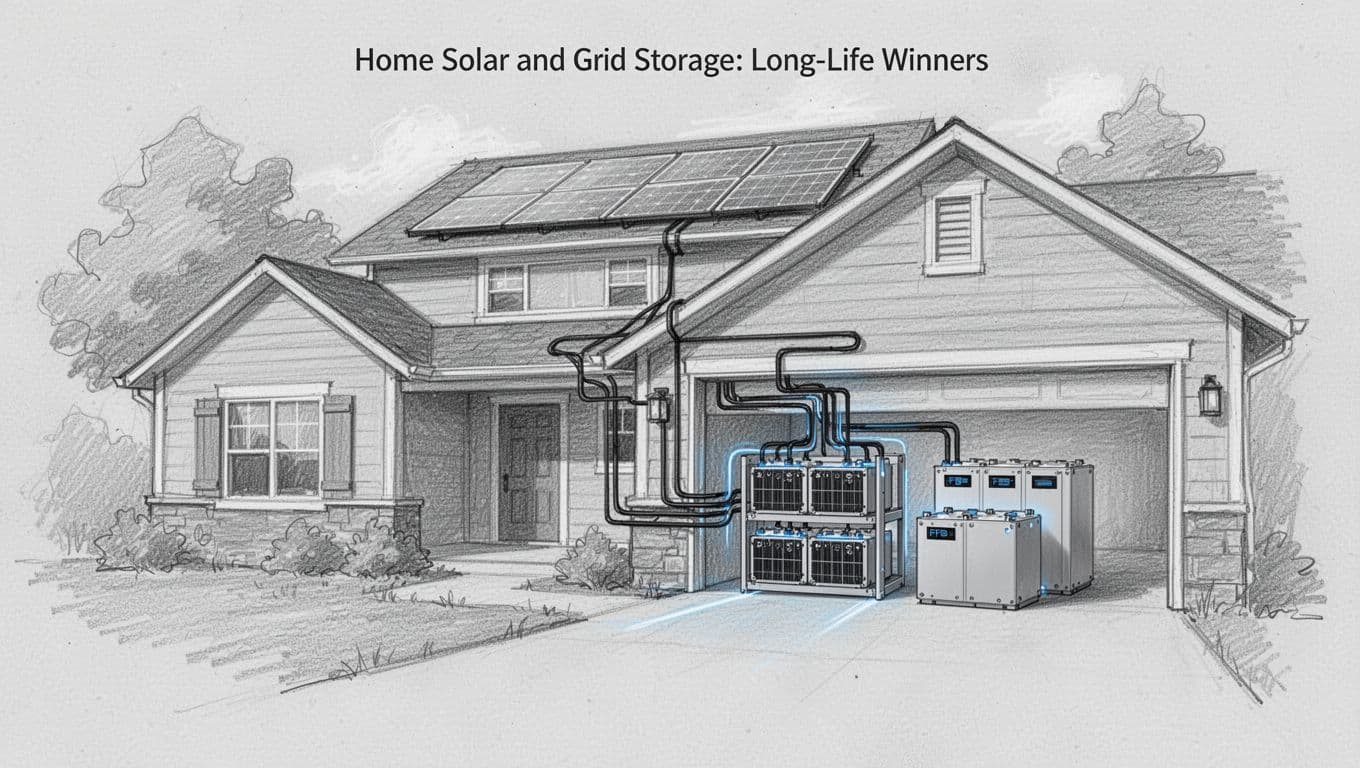
For a visual comparison of long-life home battery options, see the typical configuration below.
Why LFP is the default for daily solar cycling
Daily cycling is the deciding factor in residential storage design. Solar production peaks in daylight, and then household demand often peaks later. The battery must sit between those times and deliver power without rapid wear.
LFP’s cycle life is the main operational advantage. A battery that cycles daily for many years reduces total cost of ownership. It also reduces the chance that the storage system becomes unreliable just as you need it most.
Safety posture also drives installer choices. Many residential setups rely on standardized rack designs and safety rules. LFP’s stable behavior supports these requirements and reduces escalation risk. As system owners keep batteries in garages or utility rooms, safety planning matters as much as storage capacity.
If you want a clean comparison framework between lithium options and what it means for a home system, use Sodium-Ion vs. Lithium Home Batteries: The 2026 Energy Storage Verdict. It can help map selection logic to real install goals.
LFP and sodium-ion versus lead-acid backup
Lead-acid systems still appear in some backup arrangements, mainly because they are easy to find and low on upfront cost. However, the lifecycle math usually becomes unfavorable. Lead-acid batteries degrade faster under repeated cycling, and their weight rises quickly for a given storage amount.
In addition, lead-acid often requires stricter handling practices. Venting concerns, maintenance steps, and space needs increase operational burden. When you add frequent cycling from solar use, the battery aging accelerates. In practice, homeowners may pay less upfront but face earlier replacement.
Therefore, if the goal includes both solar shifting and outage backup, LFP typically beats lead-acid on long-term cost and practicality. Sodium-ion can also compete where it is available at attractive pricing and where installers can confirm the safety and performance profile for the local conditions.
When sodium-ion is the practical second option
Sodium-ion can make sense when your system priorities include material cost and safety, and when you accept that energy density can be lower. This means you may need more battery volume or you may need to reduce expectations for total stored energy.
However, sodium-ion’s chemistry can support stable performance in many operating ranges. It may also reduce supply risk because sodium is abundant compared to lithium-linked inputs.
Still, selection should include proof points. The homeowner should confirm warranty terms, certified safety testing, operating temperature limits, and verified cycle claims in similar residential duty. If these items align, sodium-ion can be a reasonable alternative to LFP for grid backup and solar evening load.
Home storage decision checklist for 2026
Homeowners generally need to confirm more than chemistry. The following items should be handled during purchase planning.
- Cycle duty match: confirm the battery is rated for daily cycling under your charge window.
- Usable capacity rules: verify how much of the rated capacity is actually usable in the system.
- Temperature operation: confirm performance in your climate, especially in heat and cold snaps.
- Installer compatibility: confirm the battery works with your inverter and monitoring system.
- Safety and warranty coverage: confirm local code compliance and clear warranty terms.
If these points remain aligned, then LFP generally serves as the long-life winner for most homes. Sodium-ion serves as the second path when pricing and system design meet residential constraints.
Hot New Batteries Changing the Game in 2026
Battery selection in 2026 increasingly follows a compliance pattern, not a brand preference. You choose based on risk limits, service life, and system cost, because chemistry now affects more than runtime. It also affects charging behavior, safety controls, and how often you replace hardware.
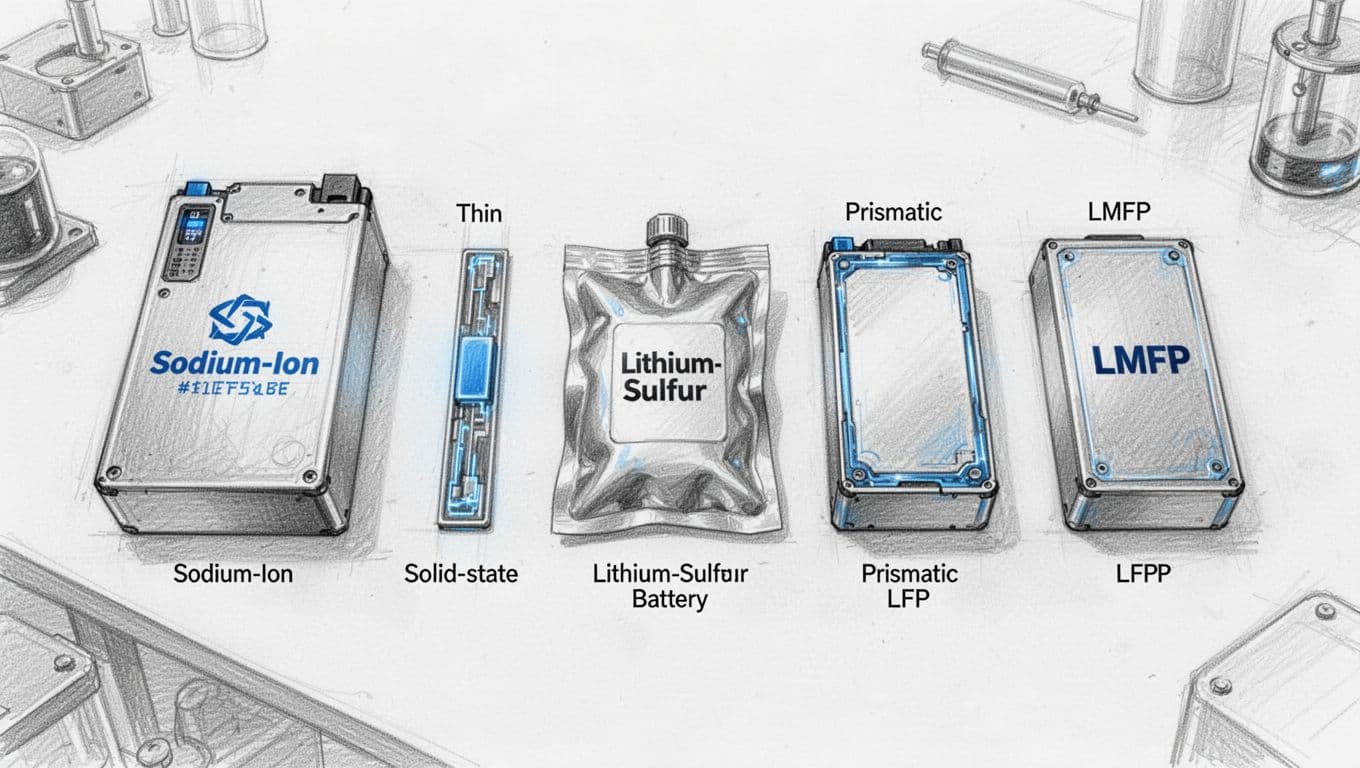
The “hot new” options do not replace every existing chemistry. Instead, they fill specific gaps where older choices underperform, such as cost pressure in grids, stricter safety rules in mass storage, and the demand for faster charging in smaller vehicles and light EVs.
Sodium-ion: Cost and safety pressure relief for grids and short EVs
Sodium-ion is moving into practical roles where price and safety drive procurement decisions. Because sodium is more available than lithium, many suppliers position sodium-ion as a lower-cost path for large deployments. At the same time, the chemistry’s behavior can simplify some safety constraints compared with older lithium designs.
In 2026, the most defensible use cases generally include:
- Grid and back-up storage, where you cycle daily or during peak demand windows.
- Short EVs and fleet micro-mobility, where range targets stay modest and weight penalties matter less.
- Systems that benefit from stable thermal behavior, where the pack can sit closer to other equipment.
Also, sodium-ion adoption tends to start where the system can absorb lower energy density. In other words, if you can add volume and still meet the installation limits, the technology can pass the “fit test” sooner. For a broader market view of how multiple chemistries compete, see The Next Battery Wars: LFP vs. LMFP vs. Na-Ion vs. Solid-State.
Operationally, you still must treat charging and temperature controls as mandatory requirements. If your charger profile or BMS logic does not match the cell limits, you will see early capacity loss.
Solid-state: Higher energy and faster charge, with adoption constraints
Solid-state batteries target two buyer priorities at once: higher energy per mass and faster charge acceptance. In policy terms, this means longer range for weight-sensitive devices, and reduced downtime for drivers and users.
However, solid-state adoption in 2026 comes with implementation conditions. Different solid electrolytes carry different production constraints, and the supply chain for those materials remains a gating factor. For practical safety comparisons across platforms, including solid-state versus lithium-ion and sodium-ion, you can reference Comparing safety profiles of lithium-ion, sodium-ion and solid-state batteries.
The most likely early rollouts tend to follow a “phase-in” method:
- Start in e-bikes, motorcycles, and smaller EVs where range goals are achievable.
- Verify charging performance under cold and hot duty cycles.
- Expand into larger EV packs once manufacturing yield stabilizes.
If you shop for solid-state enabled products, you should treat “marketing energy” as insufficient. You must verify claimed capacity at operating temperature ranges, plus warranty terms that cover fast-charging use. Without those, the effective ownership risk stays unknown.
Lithium-sulfur: High potential energy, but stability and lifetime limits remain the gate
Lithium-sulfur promises high energy potential, because sulfur stores more energy per unit mass than many conventional cathodes. For some applications, that promise translates into longer runtime in smaller packs. In other words, the chemistry can meet form-factor constraints where lithium-ion cannot.
Yet stability remains the compliance barrier. Battery life often depends on how the chemistry manages structural changes over repeated cycles. If those changes outpace the pack’s design envelope, capacity fade can become the main limiting factor.
To understand the engineering constraints behind lithium-sulfur, review Exploring the current engineering challenges of solid-state lithium-sulfur batteries. In short, the technology needs sustained progress in materials behavior, interface stability, and fault tolerance.
For buyers, the correct action is not to reject lithium-sulfur. Instead, apply strict “proof before purchase” rules:
- Confirm cycle-life claims using real test conditions, not idealized assumptions.
- Verify charge rate limits in your normal climate range.
- Ensure the pack includes monitoring that matches the chemistry’s failure modes.
LFP and LMFP boom: The near-term growth curve for predictable ownership
LFP and LMFP do not carry the same “future hype” as solid-state. Still, their near-term growth remains the most practical reason to pay attention. In 2026, the LFP/LMFP boom reflects a procurement preference for predictable lifetime, stable heat behavior, and clear integration pathways for manufacturers and installers.
You should expect LFP to remain a common default where:
- Daily cycling is required, and long service life matters.
- Safety review depends on stable chemistry behavior.
- Cost targets prioritize lifetime cost over maximum energy density.
LMFP extends the same general logic, typically by aiming for improved energy while keeping strong cycle life. In policy terms, LMFP can act as a compromise option when LFP’s bulk becomes unacceptable, but a nickel-heavy design adds risk or cost.
If you want a one-page comparison of how these newer and near-new chemistries stack up, the multi-chemistry framing in The Next Battery Wars: LFP vs. LMFP vs. Na-Ion vs. Solid-State can help you map selection logic by application.
How to choose among 2026 “new” chemistries without guessing
Selection in 2026 should follow an evidence-first requirement set. You should not choose by hype or by one lab result. Instead, choose by operational fit.
Apply these decision rules to your use case:
- Grid and outage storage: prioritize cycle life, safety behavior, and installation practicality, sodium-ion and LFP commonly align.
- Short EVs and fleets: prioritize total cost per usable kWh and charging fit, sodium-ion and LFP often align.
- Weight and fast charge targets: treat solid-state as a system-level fit problem, confirm real charging limits and warranty coverage.
- Form-factor constraints with strict validation: treat lithium-sulfur as high-potential, require documented lifetime in your duty cycle.
Before finalizing purchase, you should keep a single internal requirement record: your charge window, climate range, expected cycles per year, and acceptable replacement risk. That record will convert chemistry names into operational obligations.
Finally, stay updated by subscribing to manufacturer release notes and independent safety and performance reporting. Track changes in chemistry, cell format, and warranty terms, because the “best battery” in 2026 can shift when testing methods and integration standards improve.
Conclusion
The best battery type for 2026 depends on a single control point: your application’s duty cycle, especially whether you need high energy, high peak power, or long cycle life. For most everyday gadgets, Li-ion supports the most runtime and recharge convenience, while NiMH and alkaline can still meet lower-drain needs at lower upfront cost.
For load-heavy work, the controlling requirement becomes peak current under stress, which is why Li-ion cylindrical cells typically fit cordless drills and saws better than smaller-format chemistries. For vehicles and home storage, LFP is the most consistent choice where safety and years of cycling matter more than maximum range, with NiMH and higher-energy lithium options used when the operating profile requires it.
Next step: review your use case (device type, expected cycles per year, and climate) and confirm the recommended chemistry for a “best battery for [app] 2026” match, then check current prices and warranty terms before purchasing. What application do you need to source a battery for, and what is your typical charge and discharge pattern?