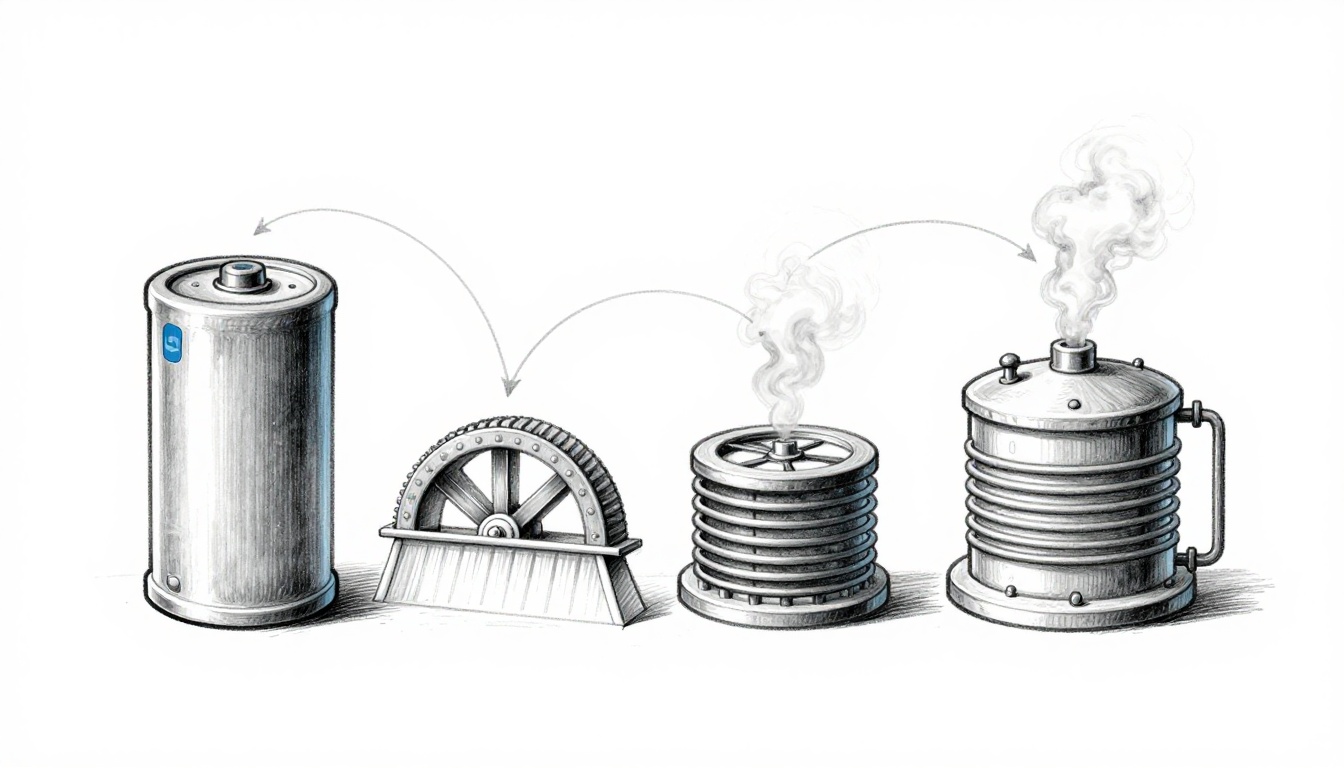
Solar and wind power do not run on a fixed schedule. They rise and fall with the weather, so grid operators often need storage to keep electricity steady, all day and night. Energy storage functions like a rainy-day savings account: it captures extra value when it is available, then pays it back when demand shows up.
In plain terms, types of energy storage technologies store energy in different forms. Later, they convert that stored energy back into electricity (or usable heat). Without this “banking” step, clean generation still produces energy, but it cannot reliably match every demand window.
This guide breaks down the main categories that matter most in 2026. First comes electrochemical storage (batteries). Next comes mechanical storage (moving matter and using physics). Then comes thermal storage (saving heat for later). Finally, hybrid and long-duration systems combine methods for steadier performance.
Each section below covers how the technology works, where it fits in real deployments, common trade-offs, and what has shifted in 2026. The intent is direct and practical, so homeowners, grid planners, and EV stakeholders can compare options without guesswork.
Electrochemical Storage: The Battery Tech Dominating Today
Electrochemical storage, commonly called battery storage, stores energy through chemical reactions inside a cell stack. When the system charges, it drives the reaction in one direction. When it discharges, the reaction reverses, and the electrical output matches the load needs. Because the conversion can happen quickly, electrochemical systems often handle short-term swings in power and can support fast grid services.
Battery systems also benefit from manufacturing scale. According to a widely cited industry guide, costs for lithium-ion storage have fallen over 85% since 2010, and typical round-trip efficiency is commonly reported in the 85% to 95% range. For a broader comparison across chemistries and use cases, see a complete guide to storage types.
In the US, 2025 added a record amount of capacity. In 2025 alone, the US added 57 GWh of new energy storage capacity, enough to support millions of homes. For 2026, expectations are higher, with installs projected near 35 GW and 70 GWh, led by utility-scale battery projects. At the same time, the market keeps shifting toward “solar-plus-storage” pairings, with about 20 GWh of new storage now tied directly to solar projects.
Meanwhile, supply chain rules keep changing what gets built. Builders increasingly shift away from certain overseas supply chains to meet US requirements for parts, so pricing pressures may stabilize in mid-2026. Also, grid-forming inverters are now more common, which helps maintain voltage and frequency during abnormal grid conditions.
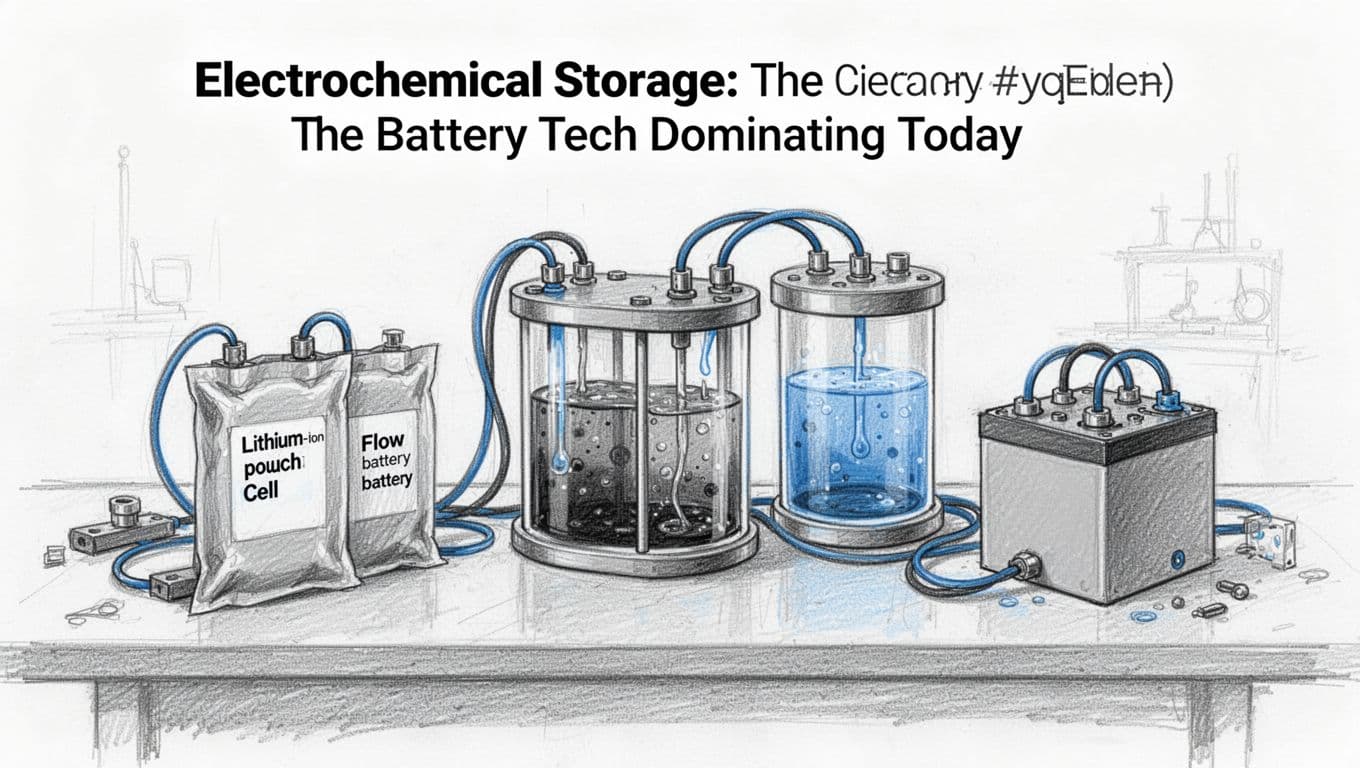
The practical consequence is simple. Electrochemical storage remains the mainstream choice for minutes to a few hours in most grid planning cases. In other words, this category is the current workhorse for balancing renewables, supporting peak demand, and powering EV charging corridors.
Key electrochemical options by fit
| Technology family | Typical discharge window | Common fit | Key trade-off |
|---|---|---|---|
| Lithium-ion | 1 to 4 hours (often) | Home backup, grid peak support, EV | Cost and safety management, sourcing and supply constraints |
| Flow batteries | 4 to 12+ hours | Grid stability and longer cycling | Lower energy density, higher material volume |
| Sodium-ion and solid-state | 1 to 4 hours (often) | Safer chemistry options, growing manufacturing | Lower density vs lithium, scaling schedules |
| Iron-air and others | 12 to 48 hours (often) | Multi-day resilience planning | Efficiency losses vs lithium-ion |
For planning purposes, discharge duration usually sets the decision, not marketing claims. Matching the duration window to the grid need reduces both cost risk and performance surprises.
Lithium-Ion Batteries: Fast Power for Everyday Needs
Lithium-ion batteries use a chemistry that allows ions to move between electrodes through an electrolyte. When charging, lithium ions travel into one electrode material. When discharging, they travel back out, producing an electrical current.
The operational strengths are consistent across most lithium-ion deployments. First, the response time is fast, often on a sub-second scale. Second, round-trip efficiency is frequently reported around 90% to 95%. Third, the systems integrate well with inverters, thermal management, and battery management systems, which improves day-to-day reliability.
In 2026 budgeting, cost still drives selection. Multiple industry summaries place lithium-ion pack pricing, in the recent market window, around $150 to $300 per kWh depending on size, duty cycle, and procurement terms. Because this category scales quickly, it also benefits from repeated design iterations across suppliers.
The limitations are also well defined. Many lithium-ion systems are not ideal for multi-day energy needs. Typical practical discharge windows often fall between 2 and 8 hours for many configurations. Also, safety requires active controls and strict installation standards. There are also ongoing supply issues tied to lithium supply and related processing capacity.
In US deployments, lithium-ion plus solar pairing continues to expand. The pairing supports daytime charging and nighttime output, which can reduce fossil generation hours. In addition, lithium-ion projects increasingly pair with grid-forming inverter controls, which improves performance during grid disturbances.
A representative home setup could include a rooftop solar array feeding a bi-directional inverter, with the battery system set to cover evening loads and short outages. If the home also participates in demand response, the battery can shift usage to reduce peak utility charges.
Flow Batteries: Built for Long, Reliable Shifts
Flow batteries store energy in liquid electrolytes contained in external tanks. During discharge, pumps move the electrolyte through a cell where the electrochemical reaction generates power. During charge, the reaction runs in the opposite direction, and the stored chemicals return to their starting state.
This design matters for planning. Because the electrolyte tanks scale separately from the cell stack, flow systems can target longer discharge windows. Many flow battery deployments target 4 to 12+ hours, and they can support high cycle counts, often cited at 5,000+ cycles when operated within designed limits.
Operationally, flow batteries are often used where the grid expects repeated cycling and where longer duration reduces the need to add extra units. In addition, the chemistry can support stronger safety profiles because energy resides in liquid systems under controlled conditions, rather than in tightly packed solid electrodes alone.
The trade-off is mainly efficiency and cost per stored energy. Energy density is typically lower than lithium-ion, so tanks and balance-of-plant equipment must be larger. Market pricing is often summarized around $300 to $600 per kWh, and site integration costs can also apply.
In 2026, flow batteries continue to gain attention for utility-scale stability programs. The key question for procurement is duration. If the grid need is longer than the common lithium-ion window, flow designs become more competitive. If the need is only short duration, the simplicity of lithium-ion often wins.
For planning clarity, flow batteries behave more like a fuel tank than a quick-start generator. They can supply energy steadily across longer windows, but they require space and system integration that must be scheduled early.
Sodium-Ion and Solid-State: Safer, Cheaper Alternatives
Sodium-ion batteries aim to reduce dependence on lithium by using sodium-based chemistry. In simplified terms, sodium ions move between electrodes through an electrolyte, similar to lithium-ion, but using different materials. Because sodium is more widely available, the cost curve can be more stable in regions where sodium processing and supply chains are expanding.
In market summaries, sodium-ion costs often show in the $100 to $300 per kWh range. Also, sodium-ion designs can offer lower safety concerns in some form factors, depending on electrolyte choices and thermal management strategy. However, performance varies by design, and energy density often trails high-performing lithium-ion packs, which can limit usable capacity for the same physical footprint.
Solid-state batteries pursue a different approach. They replace parts of the traditional liquid electrolyte with a solid electrolyte. In concept, solid-state can improve safety by reducing flammable liquid components. It can also support better packing density when manufacturing constraints are resolved.
Some industry forecasts cite solid-state systems with potential energy density targets near 400 Wh/kg under mature designs. Even so, commercialization schedules depend on yield, material supply, and stack manufacturing consistency.
For 2026, the operational story is that these chemistries are moving from pilot programs to more formal procurement pathways. Sodium-ion activity grows in markets that want supply flexibility. Solid-state manufacturing investment continues to increase because the long-term value proposition includes both safety and density improvements.
Procurement guidance for 2026 should treat sodium-ion and solid-state as “growing options,” not instant replacements for lithium-ion. The integration plan should include warranty terms, recycling pathways, and performance guarantees.
In practice, these options can become relevant for backup systems, industrial microgrids, and areas where lithium supply risk has higher cost exposure.
Iron-Air and Others: Super Cheap for Days of Power
Iron-air batteries store energy through metal-air electrochemistry, usually with iron and oxygen reactions. When discharging, the system runs a reaction that produces electrons for the external circuit. When charging, electricity reverses the process.
The main market promise is duration. Iron-air systems are often discussed for 12 to 48 hours of discharge time, which targets multi-day renewable gaps and resilience needs. That duration changes the planning economics, because one long-duration system may replace multiple shorter-duration units.
The cost story is similarly simple. Iron and air are abundant, so balance-of-materials costs can be low. Market discussions commonly describe this category as potentially super cheap for long duration service, though final installed costs depend on stack design, charging infrastructure, and system sizing.
The trade-off is efficiency. Many iron-air systems face efficiency ranges often cited around 40% to 70%, which means more energy must go into the system to get the same delivered electricity. This loss matters most when electricity is costly, or when the charging energy must be curtailed.
In 2026, iron-air remains focused on grid and data-center use cases that can justify multi-day storage. Realtime market reporting also notes a 12 GWh deal for AI data centers, which signals that large customers can value duration even when efficiency differs from lithium-ion.
Besides iron-air, other metal-based and longer-duration chemistries exist, but procurement should compare only credible duration, efficiency, and availability metrics. Multi-day storage contracts depend on delivery performance across seasons.
In short, iron-air and similar chemistries represent a future-facing category for planners who need days, not hours.
Mechanical Storage: Massive Scale Using Physics
Mechanical storage uses physical processes instead of chemical reactions. The most common mature option remains pumped hydro, which uses gravity and moving water. Other mechanical approaches use compressed fluids or spinning mass. The unifying benefit is that many mechanical systems can support long backup windows and heavy cycling without relying on battery chemistry alone.
Also, mechanical storage can provide grid services during periods when renewables drop for extended times. Because wind and solar can remain low for days in some regions, duration becomes the governing variable.
In addition, mechanical systems often face long build timelines due to permitting, site development, and engineering constraints. Yet the long life and stable operation can offset those delays over project lifetimes.
For quick context, the main mechanical options can be summarized as follows.
| Mechanical option | Duration fit | Best match | Main constraint |
|---|---|---|---|
| Pumped hydro | 8 to 24+ hours | Large grid backup | Geography and permitting |
| Compressed or liquid air | 8 to 24+ hours | Industrial-scale storage | Site and efficiency limits |
| Flywheels | Seconds to minutes | Frequency support | Limited energy per unit |
Pumped Hydro: Water Power That Lasts
Pumped hydro stores energy by moving water between two reservoirs at different elevations. When excess electricity exists, the system uses motors to pump water uphill. When electricity is needed, water flows back downhill through turbines to generate power.
This approach is proven at large scale. Many deployments aim for 8 to 24+ hours, and some designs target longer windows depending on reservoir sizes and head conditions. Market summaries often cite installed costs around $100 to $200 per kWh for suitable sites, because the main materials and civil works can scale.
However, location requirements are strict. Pumped hydro needs a suitable elevation difference, water availability, and a permitting path that fits local regulations. Construction is also slow. Therefore, pumped hydro rarely solves short-term procurement timelines on its own.
In 2026, one operational update is the development of closed-loop or non-river designs. These systems aim to reduce the requirement for natural rivers by using enclosed water circulation within the project footprint. That adjustment can broaden eligibility for locations that lack ideal open water resources.
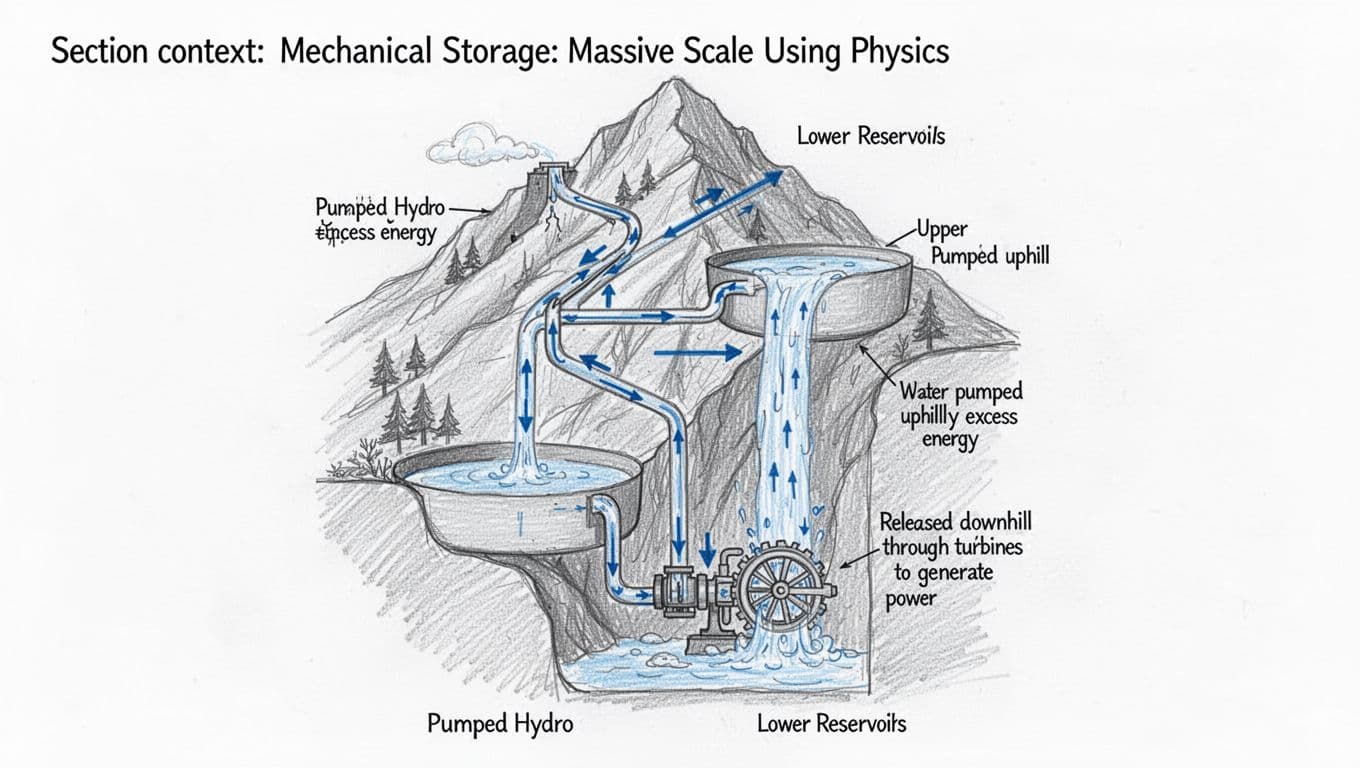
Because pumped hydro can support large-scale backup needs, it remains a central tool in grids with high renewable shares. It can also reduce the total storage capacity required to cover long low-generation periods.
Compressed and Liquid Air: Air as Energy Banks
Compressed air energy storage compresses air in underground caverns or tanks. Later, the air expands through a turbine to generate electricity. Liquid air systems cool air into a liquid form, then use re-heating and expansion to produce power.
The planning appeal is scale. Caverns can store large volumes of compressed energy, and multi-hour discharge can follow. These systems often target 8 to 24+ hours, similar to many pumped hydro planning windows.
The trade-off is efficiency and site fit. Heat losses and compression energy consumption can reduce round-trip efficiency compared with lithium-ion. Also, projects require appropriate subsurface geology for caverns, or large surface equipment for alternatives.
In 2026, compressed and liquid air systems are gaining attention where industrial demand and grid integration align. Realtime reporting points to large compressor development that can support renewables pairing and industrial load shifting. That matters because industrial users often plan for energy cycles and can accept lower efficiencies when duration needs justify the spend.
For many regions, the decision hinges on geography. If caverns or suitable storage volumes exist nearby, air-based storage can become a serious option.
Flywheels: Spinning Speed for Instant Boosts
Flywheels store energy as kinetic energy. They spin a rotor at high speed using an electric motor, then release energy as the rotor slows through a generator.
This category is not designed for multi-hour discharge. Instead, it supports very fast response. Flywheels can provide seconds to minutes of output, which helps stabilize frequency and handle short disturbances. They also support applications that require repeated power pulses without large thermal stress.
The advantage is durability. Many flywheel designs can cycle frequently because they do not rely on chemical storage media. However, the energy density per unit is lower than batteries, so the systems cannot economically cover long periods.
In 2026, flywheels often appear in hybrid designs. A common pattern uses flywheels for instant frequency support, while batteries provide the longer discharge window. This division of labor can improve overall system performance, while controlling costs.
For procurement, the question is grid role. If the need is frequency support and fast stabilization, flywheels can match the duty cycle well.
Thermal Storage: Capturing Heat for Later Use
Thermal storage captures energy as heat, not electricity. The stored heat can come from concentrated solar power, surplus electricity, or industrial processes. Later, the system converts heat back into electricity through heat exchangers and turbines, or it supplies heat directly for industrial use.
Molten salt storage represents a well-known approach. In simplified terms, the system heats a thermal medium during surplus power periods. Then it stores that heat in insulated tanks. When power is needed, the heat drives a power cycle.
Thermal storage can be cost effective for long-term storage needs. It also fits factories that can use heat directly. However, the system requires strong insulation and careful heat management. Efficiency tends to be lower than electrochemical systems, and ramp-up performance depends on the thermal design.
In 2026, power-to-heat pathways are also gaining attention because they convert excess electricity into heat when grid constraints require it. These projects align with the broader shift toward pairing generation with storage across multiple energy forms, not only electricity.
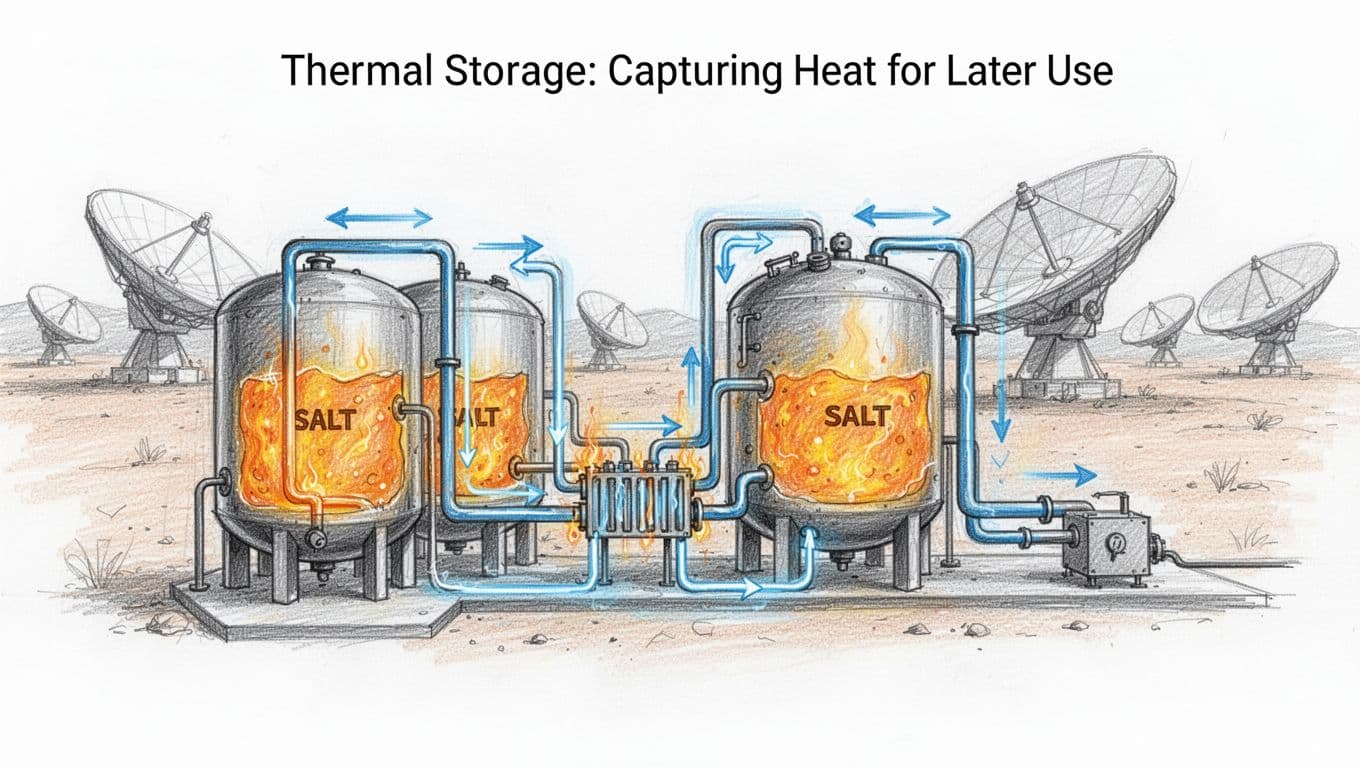
A typical emerging fit involves solar thermal plants, industrial steam loads, and regions where heat demand lines up with generation timing. In addition, hybrids that combine thermal storage with batteries can reduce costs by selecting the right tool for each duration window.
Hybrid and Long-Duration Storage: The Smart Combos
Hybrid storage blends multiple methods to control risk and improve performance across time horizons. A common example is combining batteries with flywheels. Batteries handle the primary discharge window, while flywheels supply instant power during frequency events. Another pattern is pairing a long-duration technology with faster electrochemical systems so planners do not overbuild expensive assets.
Long-duration storage (often abbreviated as LDES) targets 10+ hours of discharge, which addresses a major planning gap for renewable variability. Lithium-ion remains dominant for short-term needs, but LDES categories like flow batteries, thermal storage, and iron-air are expanding as grids seek steadier multi-hour and multi-day performance.
Market behavior supports this direction. Realtime reporting for 2026 highlights that total storage installs are expected to surge, and that pairing with solar is becoming routine. Also, grid-forming inverter standards are increasingly common, which reduces the risk of unstable power output during disturbances.
If decision-makers require an additional market view for 2026, see energy storage innovation trends in 2026. That type of synthesis usually captures which hybrid designs and long-duration contracts are gaining momentum, as opposed to isolated pilots.
Policy also matters. The Inflation Reduction Act supports domestic battery manufacturing and related supply chains. Therefore, more projects can qualify for tax credits, and procurement can prioritize domestic assembly and qualifying components.
Finally, these systems increasingly integrate into microgrids and virtual power plant strategies. That operational setup allows multiple assets to behave as one dispatchable resource. In this case, the storage technology choice must match grid rules, metering, and dispatch control requirements.
Conclusion
Energy storage technologies are not interchangeable, because each category solves a different timing problem. Batteries typically dominate where fast response and 1 to 8 hours of discharge cover the majority of daily needs. Mechanical systems, especially pumped hydro, support large-scale backup for longer windows, when geography and permitting align. Thermal storage focuses on heat capture and later power conversion, which also benefits industrial energy use. Hybrid and long-duration storage combine methods to smooth multi-hour gaps and reduce reliance on short-duration assets alone.
For 2026 planning, the clearest takeaway from current deployments is that pairing storage with renewables is now normal. US installs are accelerating, solar-plus-storage is growing, and grid-forming inverters help keep power stable. Non-lithium options also keep moving from pilots toward larger procurement, driven by the need for longer duration service.
If you are evaluating storage options, identify the duration window first, then match the technology. After that, confirm integration details like warranty terms, safety controls, recycling pathways, and dispatch requirements.
Which category looks most useful for your situation in 2026, batteries, mechanical storage, thermal storage, or a hybrid design?