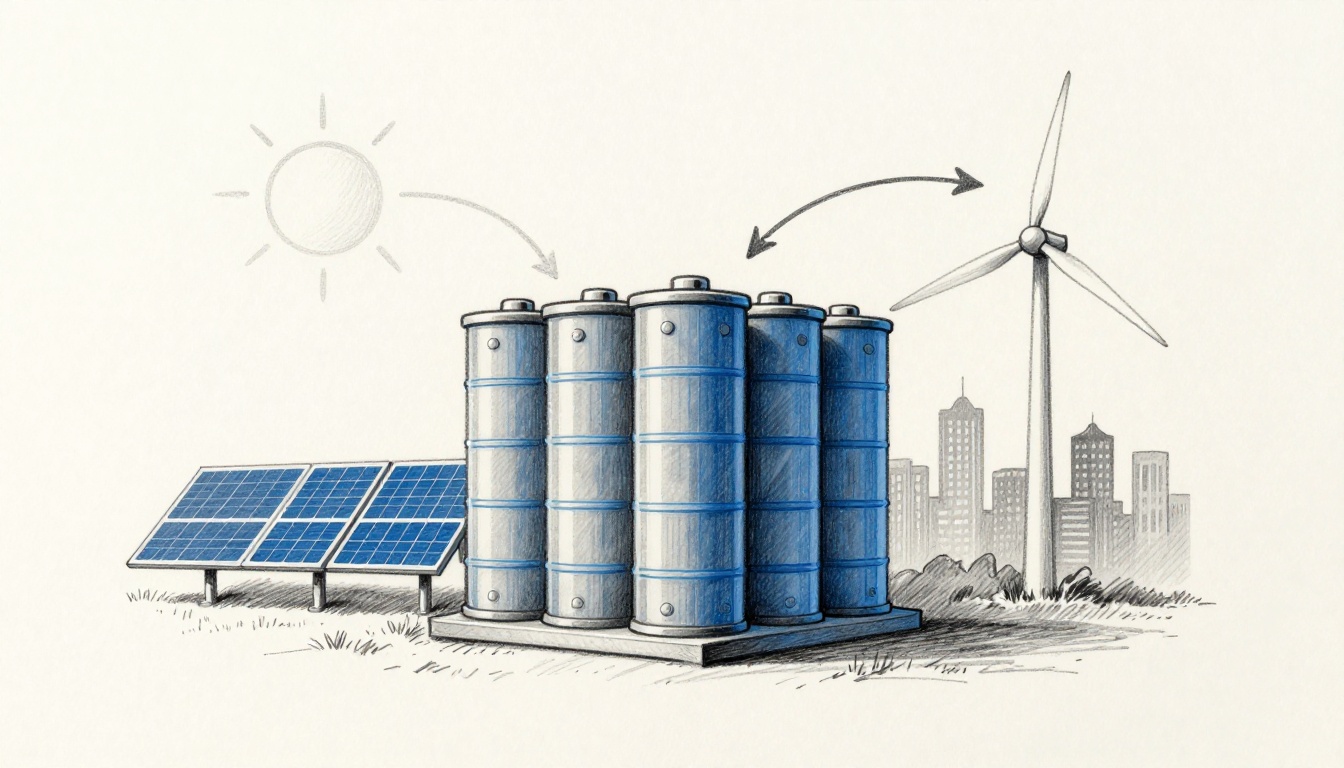
Imagine charging your phone in the morning, but needing the same power at midnight to keep your home running. That same timing problem hits the electric grid every day. Solar can produce when the sun shines, and wind can produce when conditions allow, but demand does not wait for weather.
An energy storage system (ESS) addresses this mismatch. In practical terms, an ESS captures extra electricity (or energy), keeps it in storage, and releases it later when the grid needs it. As renewable power grows, this function moves from “nice to have” to “operational requirement” for many planners and operators. Because intermittent generation cannot match load in real time, storage provides the timing and control that conventional plants used to supply.
Batteries now lead new storage deployments, with global utility-scale battery additions reaching a record 63 GW in 2024, bringing total utility-scale battery capacity to about 124 GW by end-2024. In parallel, batteries also overtook pumped hydro in growth momentum by 2022, and they kept that lead due to faster build times and lower installation friction.
The remainder of this post defines ESS in plain terms, then organizes the main technologies by how they store energy, deliver power, and fit different grid needs. The discussion also covers grid value, real-world uses, and the issues that still limit adoption, including cycle life and safety controls.
Exploring the Main Types of Energy Storage Systems
Energy storage technologies can be sorted by the physical method used to store energy. Some systems store energy through chemical reactions, others by moving fluids or spinning rotating parts, and still others store heat or create fuel. For a high-level taxonomy of major categories, see Ricardo’s overview of the four main energy storage technologies.
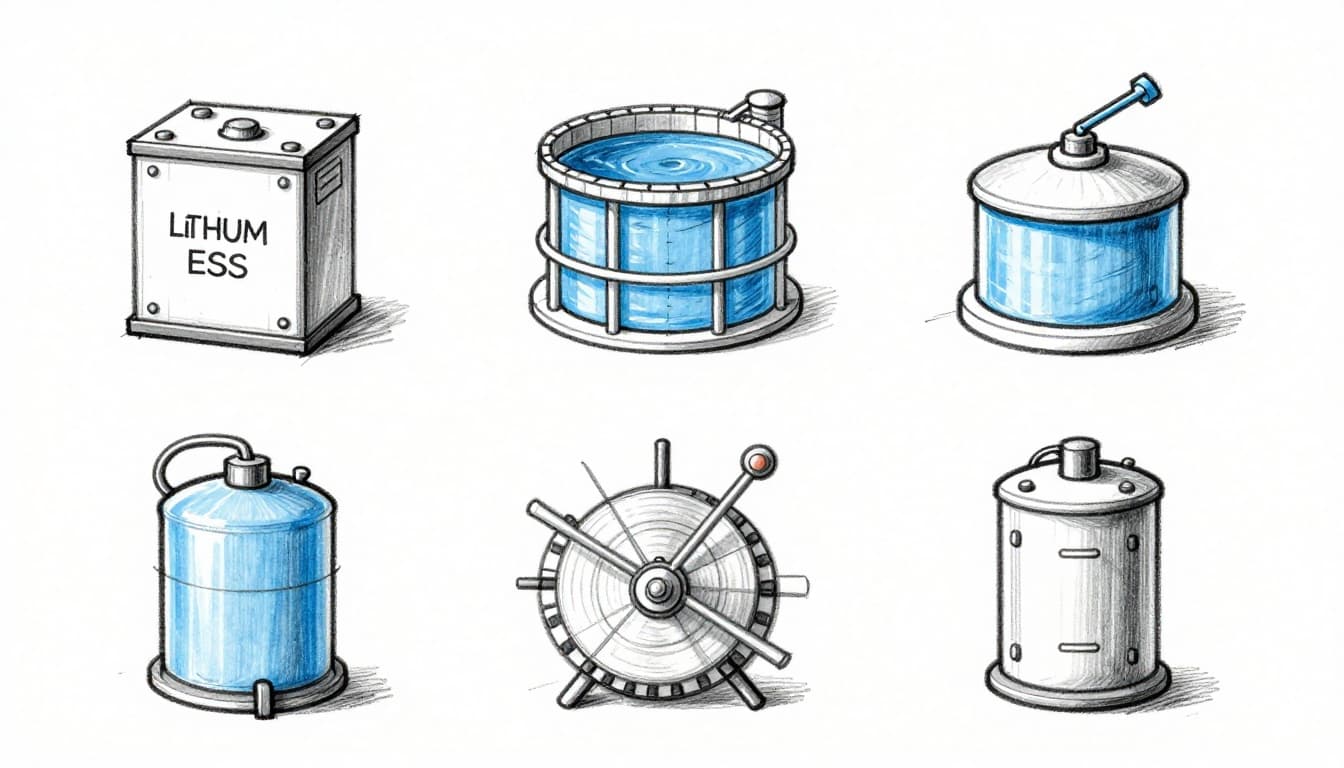
In most cases, planners also evaluate two practical attributes. First, power response time determines how quickly the system can add or reduce output. Second, energy duration determines how long it can sustain output once discharged.
Below is a compact comparison based on common use patterns.
| Technology category | Typical best-fit duration | Key operational feature |
|---|---|---|
| Lithium-ion batteries (electrochemical) | Short to medium (often 1 to 4 hours) | Fast response, widely deployed |
| Pumped hydro (mechanical) | Medium to long (often multi-hour) | Long lifetime, but site-limited |
| Compressed air and flywheels (mechanical) | Short bursts to longer systems | Suitable for dispatch and grid services |
| Thermal storage (heat or cold) | Hours to daily cycles | Decouples heat supply from demand |
| Hydrogen and supercapacitors (emerging) | Potentially long term or instant | Longer-term options and very fast response |
Battery Storage: The Go-To Choice for Quick Power
Battery storage is the dominant electrochemical option in current U.S. and global projects. The most common design uses lithium-ion cells. When the battery charges, electric energy drives chemical changes inside the cells. When the battery discharges, the same chemistry reverses, and electricity flows back through the system.
From an operational standpoint, lithium-ion systems are treated as fast dispatch resources. Their control equipment and inverter interfaces allow output changes in milliseconds under grid commands. That behavior matters when frequency drops or when net load moves due to renewable variability.
Efficiency depends on design and operating conditions, but many project evaluations cite round-trip efficiency in the 85% to 95% range for lithium-ion. That efficiency does not mean “perfect.” It means energy losses are generally lower than older storage types, and the conversion chain can be controlled tightly.
Other electrochemical options exist and may be used to match duration needs. For longer durations or different risk profiles, flow batteries can scale energy capacity by enlarging tank volume, while lead-acid systems may appear in smaller backup roles. Still, most grid-scale growth currently targets lithium-ion due to available supply chains and proven construction schedules.
For many homeowners, the battery also functions as part of a solar pairing. Instead of selling all daytime solar output immediately, a home system can store energy for later evening use. This pairing reduces curtailment risk and can cut reliance on expensive peak pricing periods, subject to local rates and interconnection rules.
Pumped Hydro and Other Mechanical Marvels
Mechanical storage covers options that store energy through physical motion. The largest deployed option is pumped hydro. In operation, the system pumps water uphill when power is available, then releases the water through turbines when power is needed. The same water acts like a “giant water battery,” where height replaces chemical energy.
Because pumped hydro uses mature turbines and generators, it can deliver high reliability. In many projects, planners cite round-trip efficiency often around 70% to 85%. Lifetime is also a major advantage; many installations can operate for decades with scheduled maintenance and major component refurbishment over time.
However, pumped hydro remains constrained by geography and permitting. Suitable head (height difference), water supply, environmental review, and land control all determine feasibility. As a result, new pumped hydro capacity does not scale as quickly as battery storage in most regions.
Other mechanical methods can complement or target specific services:
- Compressed air energy storage (CAES) stores energy by compressing air in underground caverns or tanks, then expanding it to generate electricity.
- Flywheels store energy as rotational motion, typically using high-speed rotors in low-pressure enclosures to reduce friction losses. They are most common where very fast response is required, such as frequency support or ride-through for power quality events.
In practice, mechanical options still face the same gatekeeping issue: they must fit the site, timeline, and service requirements. Where the fit exists, these technologies can deliver dependable output without relying on daily battery cycling.
Thermal Storage: Molten Salt and Ice for Steady Output
Thermal storage is defined by storing energy as heat (or cold) rather than electricity. The core value comes from shifting when thermal energy is available. In many systems, storage captures excess energy and then releases it later as usable heat or cooling.
A common grid-scale example uses molten salt in concentrated solar power plants. During sunny periods, excess energy heats the salt. Later, the system can use that stored heat to produce steam and generate electricity even after direct solar input stops.
Thermal approaches also show up in buildings and industrial demand. Ice storage, for instance, makes cooling capacity available during off-peak hours, then discharges cold water or melting ice during peak cooling demand. The result is not just comfort control. It also helps reduce peak electric demand by moving a portion of cooling load away from the hottest hours.
Efficiency varies by design. Heat losses, insulation quality, and the heat-to-electric conversion chain all affect performance. Still, thermal storage can be cost-effective when the end use is thermal energy, and when the primary goal is to shift demand rather than provide fast grid frequency response.
Emerging Options: Hydrogen and Supercapacitors
Two emerging categories often appear in 2026 project discussions: hydrogen and supercapacitors. Their roles differ, so they should not be treated as substitutes for lithium-ion.
Hydrogen storage typically starts from excess electricity. The process uses electrolysis to split water into hydrogen and oxygen. Later, the system can use hydrogen in fuel cells to produce electricity or in other industrial pathways where fuel value matters. This pathway targets longer duration in theory, because fuel can store energy beyond the typical daily cycling window. It also aligns with decarbonization strategies outside electricity generation, but it adds conversion steps and infrastructure needs.
Supercapacitors store energy through electrostatic charge, not chemical reactions. Their defining characteristic is very fast response, often in the sub-second range. This makes them suitable for short grid events, power quality ride-through, and quick regulation tasks where a small “buffer” is enough. However, they are not currently the default for long-duration energy shifting due to cost and energy density limits.
For planning purposes, these emerging tools usually appear as niche options or “future candidates,” pending demonstrations, cost curves, and safety frameworks.
How Energy Storage Systems Capture and Deliver Power Seamlessly
An ESS is rarely a single box. Instead, it includes storage elements plus conversion and control equipment. A utility-scale system typically uses:
- A storage unit (cells, water reservoirs, compressed air, rotating mass, or thermal media)
- A power converter (often an inverter for battery systems)
- A control system that follows grid dispatch signals and safety interlocks
In simplified operation, the ESS performs a repeating cycle. First, the system charges. Charging places energy into storage, usually when electricity is available in excess of immediate demand. Next, the system holds energy for a defined time window. Then it discharges when demand increases, when renewable output drops, or when grid signals require support.
Energy storage does not eliminate losses. It shifts energy across time while incurring conversion losses. Analysts often summarize this with round-trip efficiency, commonly summarized as the fraction of energy retrieved after charging and discharging. For planning, losses also translate into heat management and thermal design constraints, which therefore impact siting and operating costs.
From the grid reliability standpoint, the control response is often the decisive factor. Batteries and flywheels can support stability by responding quickly to frequency deviations. Pumped hydro can do the same, but with slower mechanical constraints. In most cases, dispatchable storage output helps prevent deeper frequency events and reduces the need for additional peaker generation.
A useful way to view ESS is as a time-shift control layer. Renewable resources act like variable inputs. Storage turns the variable input into a controlled output, according to grid needs and market dispatch rules.
For deeper context on long-duration storage planning and incentive gaps, consult NREL’s grid integration and valuation framework for long-duration energy storage.
The Big Reasons Energy Storage Is Key to a Greener Grid
The main value of an energy storage system is not abstract. It is measured as improved ability to match supply and demand under real operating conditions. Solar production changes with clouds. Wind production changes with weather fronts. Loads can change due to daily patterns and industrial schedules.
Therefore, the grid needs a way to hold energy and release it later. Storage provides that function, and it does so with controllable timing and output.
The Renewable Energy Institute frames this problem directly: renewable generation is intermittent, so energy storage becomes a parallel requirement to make clean power reliably available when needed. See why energy storage is just as important as generation.
Making Renewables Work Around the Clock
A clean grid goal usually includes 24/7 availability. Without storage, renewables must either curtail production, increase other dispatchable generation, or accept lower reliability. With storage, the system can store midday solar and release it at night, or store surplus wind and release it during calm periods.
In the U.S., this operational shift is visible in deployment patterns. Recent market reporting indicates that solar plus storage made up a major share of new grid capacity additions in 2026. That matters because storage pairing reduces curtailment and improves the ability to serve evening demand spikes.
Even where renewable penetration does not reach “full replacement” levels, storage still reduces stress. It can smooth short-term ramps caused by cloud cover. It can also reduce the need for fast-start thermal units. That combination can cut total emissions because it allows fossil units to run less often at inefficient parts of their load range.
For batteries, the practical fit is short to medium duration. For long-duration needs, pumped hydro and other long storage designs can still play a role. The key point is duration matching. A system designed for 15-minute grid events should not be treated as a 10-hour solution, and planners should not mix those requirements without a clear performance basis.
Boosting Grid Reliability and Saving Cash
Grid reliability has a financial component. When supply and demand mismatches, operators often incur extra costs for emergency response, start-up fuel, and reserve procurement. Storage can reduce these costs by acting as a dispatchable resource at the right time.
In markets with pricing signals, storage can also perform arbitrage. It charges when electricity price is low, then discharges when price is higher. It may also help with frequency regulation by adjusting output in response to system frequency signals.
Reliability improvements also extend to thermal generation management. When storage can supply short-term needs, some thermal units can run closer to their most efficient output. That can reduce fuel burn and maintenance cycling, which operators then translate into cost savings.
RMI describes batteries as a workhorse for an affordable and reliable grid when deployed with planning discipline and market rules. See Batteries: The Workhorse of an Affordable, Reliable Grid.
In compliance terms, storage value depends on market design and operational rules. If markets do not remunerate fast response or flexibility, project economics weaken. When markets do reward these services, storage becomes more than a backup asset. It becomes part of core grid operations.
Storage does not only “store energy.” It also performs a dispatch function that can lower system stress and cost exposure.
From Giant Solar Farms to Your Home: Real Uses and Future Trends
Energy storage deployment now spans multiple scales. Grid operators use large systems to stabilize regional reliability. Developers pair storage with renewable generation to expand usable output. Consumers install smaller systems to manage bill exposure and backup power.
At the utility level, the most common use cases include:
- Grid-scale batteries paired with solar and wind
- Pumped hydro where site constraints can be met
- CAES pilots and large mechanical storage concepts
- Thermal storage in concentrated solar plants
- Flywheels for high-power ride-through and fast regulation
At the customer level, the most visible use case is the rooftop solar system paired with a home battery. Instead of exporting all midday solar output, the home can shift some generation to evening hours.
Data centers also use fast storage components. Flywheels and battery systems can provide ride-through during brief grid disturbances, so critical loads can remain online.
Everyday Wins and Large-Scale Projects
On the large scale, pumped hydro remains a proven workhorse in the U.S. Even when new growth is smaller than battery growth, legacy pumped storage still provides value where it already exists. The same principle applies to CAES where geography and facilities already support it.
On the homeowner side, batteries can reduce net electricity purchases during peak time windows. In addition, backup mode can provide continuity during outages, subject to interconnection settings and generator-like operating constraints.
Wind-CAES and other hybrids also appear in project studies. The pattern is consistent: storage assets aim to control timing and reduce variability risks for the grid and for offtakers.
In a U.S. context, the current build pace is strongly shaped by batteries. Early 2026 reporting indicates the U.S. already holds a large battery base, with additional capacity coming online during 2026. This trend also supports the “solar plus storage” buildout model, where storage handles evening ramp needs that solar cannot meet alone.
Tackling Hurdles Head-On
Despite strong growth, several constraints remain.
First, cost still affects procurement decisions. Battery prices have fallen, but the total installed cost includes inverters, power conditioning, permitting, and grid interconnection upgrades.
Second, cycle life matters. A storage asset must survive repeated charge-discharge cycles while maintaining performance. Planners therefore evaluate warranty terms, degradation curves, and expected annual throughput.
Third, safety and fire controls require strict engineering. Battery systems use thermal management, monitoring, and containment. Still, regulators and fire codes demand compliance processes, and those processes can affect project schedules.
Fourth, site constraints also apply. Mechanical storage options depend on geography. Thermal storage depends on heat transfer designs. Hydrogen depends on storage, transport, and end-use pathways.
The net operational reality is that storage adoption depends on risk control and validated performance, not only on technical feasibility.
Hot Trends Shaping 2026 and Beyond
In March 2026 planning, several themes show up repeatedly.
Batteries continue to lead deployments because they are fast to build and easy to pair with solar and wind. Project pipelines also keep widening because supply chains and installation processes have matured. In addition, policy and procurement frameworks increasingly treat storage as a grid resource rather than a special-purpose accessory.
Long-duration energy storage also gets more attention, as operators seek solutions beyond the common short-duration battery window. In this category, hydrogen appears as a longer-term candidate, while pumped hydro concepts and advanced mechanical designs remain active where geography permits.
Finally, integration planning remains a core trend. Projects increasingly account for grid constraints such as transmission limits, curtailment patterns, and interconnection queue timelines.
For an example of near-term U.S. build activity, see new U.S. battery capacity in 2026, including 24.3 GW planned additions. The reporting focus on additions supports the broader takeaway: storage is no longer “future.” It is present equipment entering normal grid dispatch.
The most practical trend is not one technology winning. It is multiple technologies matching the right duration and service needs.
Conclusion
An energy storage system captures electricity or energy for later use, then delivers it under grid control. That basic function resolves a real conflict between renewable supply timing and demand patterns. As batteries accelerated their growth and deployment momentum, they became the most common ESS choice for quick power support and renewable pairing.
The major ESS types, from lithium-ion to pumped hydro, thermal storage, and emerging hydrogen and supercapacitors, differ in duration, efficiency, and site needs. Their value also includes reliability services such as frequency support and capacity shifting, plus cost control through smarter charging and dispatch.
If the opening hook described your home lights flickering when solar power is not available, the same principle applies at grid scale. The storage layer turns intermittent clean generation into dependable power, and it does so with measurable operational and financial outcomes.
If you have rooftop solar, review whether storage fits your utility rates and backup requirements. If you are planning grid or commercial projects, prioritize storage performance data, cycle life, and compliance readiness. Reliable clean energy depends on energy storage systems doing their defined job, every day.