Your phone can lose power fast, even if you planned to “charge later.” When that happens, the battery did not fail randomly. It simply used up the stored energy it had been holding in chemical form.
In plain terms, batteries store energy through reversible chemical reactions and then release it as electricity when a device draws power. The key work happens inside the cell, where an anode and cathode react, and an electrolyte controls how ions move. Meanwhile, electrons do not travel through the electrolyte, so they take the outside path that powers your circuit.
Because modern batteries like lithium-ion and older lead-acid types use the same core idea, you can understand both with the same framework. The sections below define the main parts, describe discharge step-by-step, explain charging reversal, and address common myths and near-term upgrades for 2026.
The Three Main Parts That Make Batteries Tick
A battery cell functions as a controlled conversion system. It converts energy between chemical form and electrical form, then keeps that process steady enough for safe use. While designs vary, the basic structure remains: anode, cathode, and electrolyte (plus current collectors that carry electrons to the outside circuit).
For a government-level overview of lithium-ion internals and the movement of ions, see the U.S. Department of Energy’s how lithium-ion batteries work.

Operationally, you may treat the components like this:
- Anode (negative side during discharge): Energy release begins here, because oxidation occurs and electrons leave the anode.
- Cathode (positive side during discharge): Energy release completes here, because reduction happens after ions arrive.
- Electrolyte (ion highway): The electrolyte blocks electron flow through the inside, so electrons must travel outside the cell.
This division matters because electricity for your device depends on an electron path outside the battery. The electrolyte moves ions inside, so charge stays balanced without shorting the cell.
Anode: Where Energy Gets Freed Up
In discharge mode, the anode serves as the source of electrons. When the circuit connects, an electrochemical reaction causes atoms at the anode to change state. As a result, electrons are freed into the anode’s metal network and then routed to your device.
For lithium-ion designs, the anode typically includes graphite. During discharge, lithium ions leave the anode material, then move into the electrolyte path. Electrons do not follow the ions. Instead, electrons move through the outer wire because they offer the easiest route for current.
This behavior can be summarized as a compliance-style rule: oxidation at the anode creates electrons, and those electrons must go through the external circuit for the system to do useful work. If a shortcut occurs, like a short circuit, the battery will lose energy faster and generate heat.
If you need a clear cell-level map of how the anode, cathode, and electrolyte coordinate, the explainer at how a battery cell works provides a readable breakdown of internal roles.
Cathode: The Spot That Pulls in Power
While the anode releases electrons, the cathode accepts them. In discharge mode, the cathode experiences reduction, meaning it gains electrons. At the same time, positively charged ions from the electrolyte arrive and help complete the reaction at the cathode surface.
In many lithium-ion cells, the cathode uses a lithium metal oxide material. The specific chemistry differs by battery type and intended performance, but the procedural logic remains the same. Ions arrive, electrons arrive through the external circuit, and the cathode reaction consumes both, which keeps current flowing steadily.
This is also where the battery’s voltage comes from. The cell’s internal chemical positions set an energy difference. When discharge begins, the system permits a reaction path that produces electrons flowing toward the cathode. As long as reactants remain available, the cathode keeps accepting electrons without stopping the chain.
Electrolyte: Keeping the Balance Without Shortcuts
The electrolyte’s duty is not to move electrons. Its duty is to move ions while preventing direct electron mixing. Therefore, it functions like a regulated channel for charge carriers.
Because ions are charged particles, they can travel through the electrolyte under the electric field created inside the cell. However, electrons are much more difficult to transport through that same material. In addition, many battery designs use a separator layer to reduce the risk of internal contact between electrodes.
Most lithium-ion batteries use an electrolyte that is liquid or gel-like. Lead-acid batteries instead use sulfuric acid as the ionic medium. Although the physical form changes, the operational requirement remains: ions move inside; electrons go outside.
A practical analogy may be used for clarity. Ions act like trucks routed through a toll tunnel, while electrons act like people who still must walk through the outside hallway. The battery does not “send” electron traffic through its electrolyte. It forces the current to do work on the outside first.
The battery releases energy only when electrons take the external path that powers your device.
Releasing Energy: Step-by-Step Discharging Action
Discharging converts stored chemical energy into electrical energy. The conversion depends on a chain of reactions that must occur in the correct order and at the correct surfaces.
In a connected circuit, current begins because electron flow becomes continuous. The internal reactions then keep pace with that demand. If the device pulls more current, the chemistry must respond fast enough, which can reduce performance and shorten runtime.
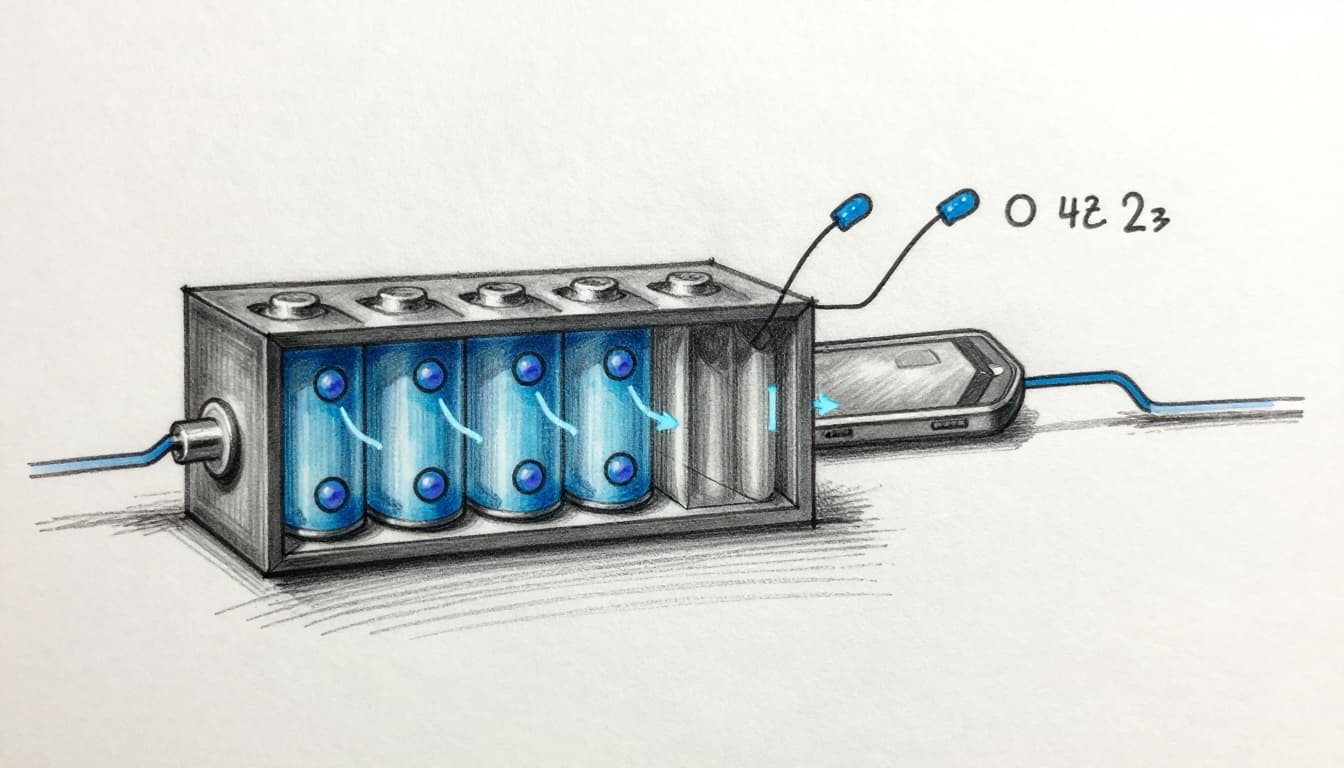
The steps below summarize the process in a device-friendly sequence.
- Anode oxidation releases electrons. Electrons enter the anode’s conductive path.
- Electrons travel outside through your device. The current does work, such as turning a motor or lighting a screen.
- Ions move through the electrolyte toward the cathode. Ions keep charge balance inside the cell.
- Cathode reduction consumes electrons and ions. The reaction maintains the cell’s discharge flow.
- The cycle continues until reactants deplete. The battery voltage declines as the cell reaches near-empty conditions.
The overall result is stable current only while chemical reactants still exist at usable levels. After that, the internal reactions cannot sustain the same electron production rate.
To compare two familiar battery types, the table below identifies what changes and what stays consistent.
| Battery type | Primary energy process | What your device “sees” |
|---|---|---|
| Lithium-ion (phones, laptops) | Lithium-ion transfer between electrodes | Voltage drops as ions deplete |
| Lead-acid (car starters) | Lead chemistry in sulfuric acid | Current drops as reactions change plates |
What Happens in a Lithium-Ion Battery
In lithium-ion discharge, lithium ions move from the anode to the cathode through the electrolyte. At the same time, electrons move through the external circuit to power the load.
As ions leave the anode host material, the anode chemistry shifts. Then, ions insert into the cathode host where the cathode reaction occurs. The cell’s design allows many cycles, since charging later reverses the reaction direction.
In real devices, the battery management system limits current and temperature. These controls do not change the core physics. Instead, they keep the reaction within safe bounds and reduce the chance of overheating, swelling, or rapid aging.
Lead-Acid Batteries in Action
Lead-acid batteries operate under the same general rule: chemical changes at electrodes produce electrons for the outside circuit. However, the materials and reaction products differ.
In a typical lead-acid cell, discharge involves lead dioxide on the positive side and sponge lead on the negative side, with sulfuric acid as the electrolyte. During discharge, both electrode materials react with the acid, and the cell forms products that affect future recharge ability.
For a simple explanation of the discharge chemistry, see lead acid battery electricity explained.
Operationally, the car starter needs a high current burst. Lead-acid cells can deliver that current, but they also suffer wear from deep discharge and long periods of being undercharged.
Storing It Back: The Reversal of Charging
Charging reverses the direction of the chemical reactions. Because discharge depleted specific chemical states, charging rebuilds them.
When you plug a charger in, it supplies electrical energy to the cell. The battery management circuitry then enforces current and voltage limits. As charging proceeds, electrons move in the opposite direction through the external circuit. Meanwhile, ions travel back through the electrolyte to return to their original electrode materials.
For lithium-ion charging, lithium ions travel back to the anode. The cathode and anode chemistries shift back toward their charged states. For lead-acid charging, the sulfuric acid and electrode plate states reverse, so the battery can provide starting power again.
Cycle life depends on how fully and how often you charge and discharge. Stress factors include high heat, long time spent at high state of charge, and repeated fast charging beyond the cell’s rated limits. Therefore, battery makers set charging profiles that balance speed and longevity.
A clear policy statement for safe operation is this: use the battery’s intended charger and charging method. When charging occurs at the wrong rate or temperature, internal reactions may form unwanted byproducts, which reduces capacity over time.
Myths About Batteries Debunked for Good
Battery misinformation persists because people remember surface-level rules, not internal chemistry. Some claims are harmless, but others cause predictable harm. The following myths should be treated as non-authoritative statements.
For additional context on common myths, see battery myths debunked.
Myth 1: Batteries store “electrons”
Batteries do not store free electrons like a wire pile. Instead, they store energy in chemical bonds and in the charged state of electrode materials. During discharge, electrons appear at the anode because the reaction creates them. Then, they flow through the outside circuit to do work.
Myth 2: Electrolyte carries electrons
This statement fails the basic separation rule. The electrolyte blocks or limits electron movement across the cell interior. It permits ionic movement to balance charge. Therefore, electrons remain on the external path that powers your device.
A battery that let electrons bypass the outside circuit would act as a heater, not a power source.
Myth 3: “More charging” always means “better”
In fact, charging too much or holding a full charge too long can increase wear. The rate and temperature of charge matter, as do the battery chemistry limits. As a result, battery life depends on charging habits, not just charging frequency.
Exciting Battery Upgrades Coming Your Way by 2026
Battery improvements in 2026 are driven by three requirements: higher energy, safer operation, and longer cycle life. Current reporting focuses on solid-state approaches, silicon-based anodes, and sodium-ion systems for certain use cases.
In March 2026 reporting, solid-state batteries continue to draw attention because they replace liquid electrolyte with solid materials. That change can reduce leak risks and support safer designs in electric vehicles. Some releases also cite higher energy density targets, and accelerated cycle performance claims appear in prototypes and early products.
Silicon anodes also remain a major focus. Silicon can store more lithium than graphite in many designs, which may increase capacity without the same size jump. However, silicon expansion during cycling can cause cracking and loss of contact. Research therefore aims to improve how silicon changes shape during charge and discharge.
For an example of technical review coverage on silicon-based anodes in solid-state systems, see silicon anodes in solid state batteries.
Finally, sodium-ion batteries keep moving forward as a lower-cost alternative. Sodium is more available than lithium, which can matter for large grid projects and budget-friendly devices. Recent research reports also focus on how ions move and how cathode materials handle fast charging conditions.
The near-term goal is not just more power. The operational goal is steadier power across many cycles.
Conclusion
Batteries store and release energy by running reversible chemical reactions at the electrodes. During discharge, the anode generates electrons, the electrolyte routes ions, and the cathode completes the reaction. Charging reverses the process so the battery returns to its stored state.
When you understand how the anode, cathode, and electrolyte coordinate, battery behavior stops feeling random. You can also evaluate myths with clearer logic, and you can follow 2026 upgrades with informed expectations.
If your current routine involves frequent deep drains or high-heat charging, review it. Then share your biggest battery question in the comments, or read another explainer on cell behavior to keep the concept grounded.